I recently started getting emails with satellite images of earth's surface and weather from someone at NASA. I never subscribed for this, and I don't know who this person is. How irritating. She apparently works for the Office of Public Affairs, so I will give her the benefit of doubt... for a minute.
Maybe she thought I'd be interested because I write a space science blog--I'm not. I'm really only interested in weather that affects me and my own observing. I don't have time to examine images of icebergs off the coast of Australia or storm clouds over the Indian Ocean. I have RSS feeds, my Google reader and some small programs that crawl the web for things I am likely to be interested in, BECAUSE I don't have time to read everything.
I'm hoping this is just an honest mistake, and she didn't presume to just start sending me email with large image files attached. My email rejects most of the Viagra and penis enlargement email these days. I really don't want it to have to block message from NASA!
I've called her office and emailed to see if we can clear this up. I'll let you know...
Showing posts with label Cranky Blogs. Show all posts
Showing posts with label Cranky Blogs. Show all posts


Carnival of Space #119-Wag of the Finger!
Blogger, Emily Lakdawalla, at the Planetary Society Blog has done a fantastic job of pulling together a collection of astronomy and space offerings for this week's Carnival of Space #119.
There are two variable star related pieces in this week's Carnival. Variable by Nature from a new friend and AAVSO member "AstroSwanny", and the Simostronomy piece on a gorgeous astrophoto from John Chumak, Epsilon Aurigae the Beautiful.
 TIP OF THE HAT
We have to give a 'tip of the hat' to the AARTScope Blog. He's really come on and done a fine job. Not just because he's another blogger who does variable stars and writes about them, but he's keeping it real, factually and actually.
WAG OF THE FINGER
 This week we have to give a 'wag of the finger' to the Chandra blog. They only publish a blog entry once per week on average, and someone is getting paid to do that. I understand that a lot of what Chandra is doing today we won't find out about until the astronomers working with the data publish it or release the embargo. But, to publish a paltry three paragraphs with a boring picture of an object that has been well-studied since the 60's when you have a whole week to come up with something is pretty lame.
Cygnus X-1 is an amazing and crazy system with a black hole and a blue supergiant star in orbit around each other. I'm inspired to write a 'rest of the story' kind of piece just because they did such an excellent job of not telling you all about this first-of-its-kind-to-be-discovered binary. Here is an interesting artists interpretation of this fascinating pair of objects-

But for one of NASA's most important space telescope missions to publish a blog with the table of contents title "supernovas" really is disappointing and irritating. What's even worse, in my opinion, is the link from this listing points to a whole page called 'taxonomy/term/five' with all their articles on SUPERNOVAS and supernova remnants. I find it disturbing that NASA has begun to imitate our public school system in its lackadaisical attitude towards correct terminology. Either someone in charge doesn't know the correct term is supernovae, or they've made a conscious effort to dumb it down for public consumption. I find both objectionable.
A lot of terms in astronomy seem archaic and unnecessarily difficult, but part of science is learning to speak the common language of whatever discipline you are engaged in. As someone who is working hard all the time to inspire young people to become all they can be, and to pique their interest in astronomy and space science, I assure you I am not working that hard hoping they will grow up to be scientists and engineers who can't spell or use the proper terminology for the branch of science in which they choose to work. I find it hard to believe the Harvard-Smithsonian Center for Astrophysics thinks its okay to have the word supernovas plastered all over the Chandra blog.
If you're going to publish a blog under the domain of dot edu, and have pages titled taxonomy, then you ought to make sure you are edu'ing the public with the correct terminology.
There have been several well known science bloggers and publishers railing against the state of science journalism in the new Internet age, and as much as I resist engaging in political or social discussions here, I think you can be sure Simostronomy will be weighing in soon.
There are two variable star related pieces in this week's Carnival. Variable by Nature from a new friend and AAVSO member "AstroSwanny", and the Simostronomy piece on a gorgeous astrophoto from John Chumak, Epsilon Aurigae the Beautiful.
 TIP OF THE HAT
We have to give a 'tip of the hat' to the AARTScope Blog. He's really come on and done a fine job. Not just because he's another blogger who does variable stars and writes about them, but he's keeping it real, factually and actually.
WAG OF THE FINGER
 This week we have to give a 'wag of the finger' to the Chandra blog. They only publish a blog entry once per week on average, and someone is getting paid to do that. I understand that a lot of what Chandra is doing today we won't find out about until the astronomers working with the data publish it or release the embargo. But, to publish a paltry three paragraphs with a boring picture of an object that has been well-studied since the 60's when you have a whole week to come up with something is pretty lame.
Cygnus X-1 is an amazing and crazy system with a black hole and a blue supergiant star in orbit around each other. I'm inspired to write a 'rest of the story' kind of piece just because they did such an excellent job of not telling you all about this first-of-its-kind-to-be-discovered binary. Here is an interesting artists interpretation of this fascinating pair of objects-

But for one of NASA's most important space telescope missions to publish a blog with the table of contents title "supernovas" really is disappointing and irritating. What's even worse, in my opinion, is the link from this listing points to a whole page called 'taxonomy/term/five' with all their articles on SUPERNOVAS and supernova remnants. I find it disturbing that NASA has begun to imitate our public school system in its lackadaisical attitude towards correct terminology. Either someone in charge doesn't know the correct term is supernovae, or they've made a conscious effort to dumb it down for public consumption. I find both objectionable.
A lot of terms in astronomy seem archaic and unnecessarily difficult, but part of science is learning to speak the common language of whatever discipline you are engaged in. As someone who is working hard all the time to inspire young people to become all they can be, and to pique their interest in astronomy and space science, I assure you I am not working that hard hoping they will grow up to be scientists and engineers who can't spell or use the proper terminology for the branch of science in which they choose to work. I find it hard to believe the Harvard-Smithsonian Center for Astrophysics thinks its okay to have the word supernovas plastered all over the Chandra blog.
If you're going to publish a blog under the domain of dot edu, and have pages titled taxonomy, then you ought to make sure you are edu'ing the public with the correct terminology.
There have been several well known science bloggers and publishers railing against the state of science journalism in the new Internet age, and as much as I resist engaging in political or social discussions here, I think you can be sure Simostronomy will be weighing in soon.
C'mon Man!
ESPN football coverage has a bit they call "C'mon Man!", where they explain their disgust or exasperation at stupid plays or calls in NFL games of the week.
I think we need to start one for astronomy journalism here.
My first entry was about a supernova in Puppis poorly reported in the press.
Well, here is the second, in what I hope will be a short list, of stupid science mistakes reported by NASA or other professional sources, blindly repeated by the press. Recently posted, and reproduced all over the web was this comment on a Hubble multi-broad-band image of the great globular cluster, M13 in Hercules.
"Like a whirl of shiny flakes sparkling in a snow globe, NASA's Hubble Space Telescope catches an instantaneous glimpse of many hundreds of thousands of stars moving about in the globular cluster M13, one of the brightest and best-known globular clusters in the northern sky. This glittering metropolis of stars is easily found in the winter sky in the constellation Hercules."
These space telescope people have got to get it together. Hercules is not easily visible in the winter sky. Any amateur astronomer who has observed ANY Messier objects can tell you winter is about the only time you can't see this globular cluster!
C'mon Man!
I think we need to start one for astronomy journalism here.
My first entry was about a supernova in Puppis poorly reported in the press.
Well, here is the second, in what I hope will be a short list, of stupid science mistakes reported by NASA or other professional sources, blindly repeated by the press. Recently posted, and reproduced all over the web was this comment on a Hubble multi-broad-band image of the great globular cluster, M13 in Hercules.
"Like a whirl of shiny flakes sparkling in a snow globe, NASA's Hubble Space Telescope catches an instantaneous glimpse of many hundreds of thousands of stars moving about in the globular cluster M13, one of the brightest and best-known globular clusters in the northern sky. This glittering metropolis of stars is easily found in the winter sky in the constellation Hercules."
These space telescope people have got to get it together. Hercules is not easily visible in the winter sky. Any amateur astronomer who has observed ANY Messier objects can tell you winter is about the only time you can't see this globular cluster!
C'mon Man!
Photon Withdrawal
For the first time in ages, I have been shut out by the weather for an entire month. My last observation report is dated October 30, 2008. The whole month of November has been cloudy. We've already had snow twice and are expecting something like 6-8 inches on the ground by Monday evening.
I've managed to keep very busy, getting a lot done at work and spending the week around full moon in Cambridge at AAVSO headquarters for meetings with the Director and staff. But enough is enough! I need some starlight to get my attitude right again.
I'd even settle for a couple so-so nights to complete shaking down the CCD telescope. Even that looks unlikely in the next week or so.
The upside is I'll have a little more time to devote to the blog in the coming week. I have a half dozen articles in various stages of completion, and I hope to publish a few of them soon.
I've managed to keep very busy, getting a lot done at work and spending the week around full moon in Cambridge at AAVSO headquarters for meetings with the Director and staff. But enough is enough! I need some starlight to get my attitude right again.
I'd even settle for a couple so-so nights to complete shaking down the CCD telescope. Even that looks unlikely in the next week or so.
The upside is I'll have a little more time to devote to the blog in the coming week. I have a half dozen articles in various stages of completion, and I hope to publish a few of them soon.
Comments on Comments
As you may have noticed, I temporarily removed the option to place comments on this blog.
My philosophy has always been to encourage free speech on the blog. I never censored any comments, I never blocked anyone from commenting and I've tried to be fair and honest in answering the comments made on the blog, especially those opinions that may have been different than mine.
Apparently, some people thought it their prerogative to use my blog's comment section as a battleground for an ongoing, personal argument. It got to the point that neither of them was commenting on the actual blog article in question, they were just pissing on each other in my blog site. It got totally out of hand, so I just shut it down.
Now that I've had a few days to cool off and think this over, I've decided to bring up the comments section again. I think it is an important part of a blog and I will not let rude, immature, inconsiderate pricks wreck my blog. I will be approving the comments before they get posted, so in effect I will be censoring them. I'm sorry its come to this, but it has.
I've taken down the whole article on VSX that started this disaster, because it is the only way I can censor the objectionable comments. This is particularly irksome to me because that blog article was the one linked to the Carnival of Space hosted here on Simostronomy. It is now a broken link thanks to these two. I will be posting a revised version of it, taking into account the "reasonable" comments that were posted before the comments turned into a personal flame fest.
The worst part is these were not anonymous spammers, but people I know. One I even considered a friend. I may forgive them one day, but I will never consider either of them a friend after this. And you can be sure they will never be allowed to comment on this blog or any other site I control, ever.
My philosophy has always been to encourage free speech on the blog. I never censored any comments, I never blocked anyone from commenting and I've tried to be fair and honest in answering the comments made on the blog, especially those opinions that may have been different than mine.
Apparently, some people thought it their prerogative to use my blog's comment section as a battleground for an ongoing, personal argument. It got to the point that neither of them was commenting on the actual blog article in question, they were just pissing on each other in my blog site. It got totally out of hand, so I just shut it down.
Now that I've had a few days to cool off and think this over, I've decided to bring up the comments section again. I think it is an important part of a blog and I will not let rude, immature, inconsiderate pricks wreck my blog. I will be approving the comments before they get posted, so in effect I will be censoring them. I'm sorry its come to this, but it has.
I've taken down the whole article on VSX that started this disaster, because it is the only way I can censor the objectionable comments. This is particularly irksome to me because that blog article was the one linked to the Carnival of Space hosted here on Simostronomy. It is now a broken link thanks to these two. I will be posting a revised version of it, taking into account the "reasonable" comments that were posted before the comments turned into a personal flame fest.
The worst part is these were not anonymous spammers, but people I know. One I even considered a friend. I may forgive them one day, but I will never consider either of them a friend after this. And you can be sure they will never be allowed to comment on this blog or any other site I control, ever.
"Hello, Operator. Mis-information, please."
I really try to be positive in my blog postings. As I have said before, there are enough cranky, crabby blogs out there, and this will not be one of them. But once in a while something is going to come up that ruffles my feathers and I'm going to be tempted to get cranky. Well, it's happened again. I'll try to use restraint.
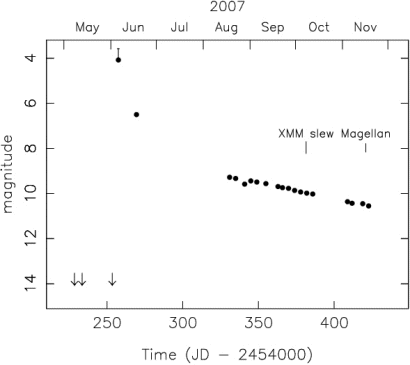
This all revolves around the recent postings regarding the "supernova" V589 Puppis, that was "missed by legions of star watchers around the planet".
The only things remarkable about this story are 1) the fact that for the first time in history, a galactic nova was discovered by its x-ray emissions months after the initial outburst and 2) that this was so inaccurately reported 10 months after the fact by one of the more respectable astronomy sites in the universe today.
Here is the condensed version of the story with links to more information if you wish to investigate further. In October of 2007, the satellite XMM-Newton serendipitously discovered a transient x-ray source as it was slewing from one target to the next. This is known as the XMM-Newton Slew Survey. It's a clever way to maximize the use of the satellite. They're doing a survey of the sky even as they slew from one scheduled target to the next. This initial discovery was announced in an Astronomers Telegram in mid November. At this point all they knew was that it was very bright in x-rays, probably in our galaxy and might even be relatively close.
To follow up on this discovery a search for an optical counterpart was conducted. A normally 16th magnitude star in the vicinity of the x-ray event was identified as being brighter than normal. Spectra were taken of this star revealing emission lines typical of a galactic nova. Further investigation of the All Sky Automated Survey (ASAS) data for this star showed a couple lucky data points that the survey just barely managed to catch. The ASAS light curve, especially if it had a few more points in the declining part of the curve, would look very much like your typical nova. Case closed, the spectra indicate nova and the light curve says nova. It's a nova. NOT a supernova.
Unfortunately the sloppy reporting of this even reaches to the European Space Agency's XMM-Newton page where they write "Having been identified as a nova, the star was designated V598 Pup by the IAU." Actually, it is the General Catalog of Variable Stars (GCVS) that assigns names to novae, not the IAU. And thank God for that, seeing as how the IAU can't even figure out what to call Pluto and her friends. But that is another story for another cranky blog.
There's more! Many of the articles written about this discovery claim it must be some kind of miracle that this 4th magnitude, naked eye event wasn't noticed by the droves of amateur sky watchers and nova hunters looking up at the sky in June last year. I'm sorry, but any amateur astronomer who actually looks at the sky can tell you that in June and July Puppis is essentially in conjunction with the SUN! It's up during the day. You can't see it from Earth. The Sun is in the way! That's why I said the ASAS points were 'lucky'. That's also why they missed the rapid decline phase in July.
Only a professional astronomer who only observes with a space telescope would boldly claim “Anyone who went outside that night and looked towards the constellation of Puppis would have seen it.” C'mon, dude. The reason you didn't find it until months later is because you can't point your space telescope anywhere near the Sun or it will blow up. Not any more then I can see Puppis at night in June.
Now that would be a miracle.
This all revolves around the recent postings regarding the "supernova" V589 Puppis, that was "missed by legions of star watchers around the planet".
The only things remarkable about this story are 1) the fact that for the first time in history, a galactic nova was discovered by its x-ray emissions months after the initial outburst and 2) that this was so inaccurately reported 10 months after the fact by one of the more respectable astronomy sites in the universe today.
Here is the condensed version of the story with links to more information if you wish to investigate further. In October of 2007, the satellite XMM-Newton serendipitously discovered a transient x-ray source as it was slewing from one target to the next. This is known as the XMM-Newton Slew Survey. It's a clever way to maximize the use of the satellite. They're doing a survey of the sky even as they slew from one scheduled target to the next. This initial discovery was announced in an Astronomers Telegram in mid November. At this point all they knew was that it was very bright in x-rays, probably in our galaxy and might even be relatively close.
To follow up on this discovery a search for an optical counterpart was conducted. A normally 16th magnitude star in the vicinity of the x-ray event was identified as being brighter than normal. Spectra were taken of this star revealing emission lines typical of a galactic nova. Further investigation of the All Sky Automated Survey (ASAS) data for this star showed a couple lucky data points that the survey just barely managed to catch. The ASAS light curve, especially if it had a few more points in the declining part of the curve, would look very much like your typical nova. Case closed, the spectra indicate nova and the light curve says nova. It's a nova. NOT a supernova.
Unfortunately the sloppy reporting of this even reaches to the European Space Agency's XMM-Newton page where they write "Having been identified as a nova, the star was designated V598 Pup by the IAU." Actually, it is the General Catalog of Variable Stars (GCVS) that assigns names to novae, not the IAU. And thank God for that, seeing as how the IAU can't even figure out what to call Pluto and her friends. But that is another story for another cranky blog.
There's more! Many of the articles written about this discovery claim it must be some kind of miracle that this 4th magnitude, naked eye event wasn't noticed by the droves of amateur sky watchers and nova hunters looking up at the sky in June last year. I'm sorry, but any amateur astronomer who actually looks at the sky can tell you that in June and July Puppis is essentially in conjunction with the SUN! It's up during the day. You can't see it from Earth. The Sun is in the way! That's why I said the ASAS points were 'lucky'. That's also why they missed the rapid decline phase in July.
Only a professional astronomer who only observes with a space telescope would boldly claim “Anyone who went outside that night and looked towards the constellation of Puppis would have seen it.” C'mon, dude. The reason you didn't find it until months later is because you can't point your space telescope anywhere near the Sun or it will blow up. Not any more then I can see Puppis at night in June.
Now that would be a miracle.
The Manners of Skeptisism
I've read and heard far too many political, religious and skeptical rants on what I thought were supposed to be science blogs, podcasts and television shows lately, and it's got me stirred up. So I'm writing one of my own just to get it off my chest.
I admit to being an atheist, and I don't think much of UFO claims, ghost sightings or psychic powers, but I don't close the door entirely on any of this stuff. I'm skeptical, and in the end, all I want is someone to show me proof. Then you can win the argument.
It would be comforting to know that God is somehow responsible for all this mess and beauty at the same time. It would be exciting to finally know for sure we are not alone in the Universe. It would be fun to come back and haunt some of the people I've known in my life after I'm gone, or check in on the great-great-great grandkids one day from the beyond.
Mostly, I avoid getting in these discussions because I've found that the people who rabidly defend their point of view are never interested in hearing your point of view. It is always a one way conversation. No one listens to the other person. It's futile and a waste of time. You are not going to change their mind suddenly with your brilliant argument today.
That is why I wonder at the attitude of so many of the 'skeptics' who write blogs, author books, do podcasts and appear on TV. I've grown as disinterested in reading or hearing their rants as I am of hearing the rants of the fanatics and religious zealots they are so eager to discredit. To me, they come off as arrogant, sarcastic, egotistical, inflexible, bitter, and just plain rude. I don't care how many books you've written, or how many degrees you have, you don't know EVERYTHING. Many of these skeptics act like they DO know everything. Apparently there is a God, and THEY are He.
Infinitely worse, and far more annoying, is the way they talk about anyone who doesn't agree with them. In the "world according to skeptics" if you don't think like they do, believe in what they do, or disagree with them, you are obviously undereducated, narrow-minded, ignorant, j-holes not worthy of breathing the same air as the almighty brilliant ones. The skeptics I'm referring to often condescend to the people who disagree with a wink and a nod to their readers or audience, as if to say, "Just look at these stupid losers. We know how pathetic they are."
The other night I watched Phil Nye, the science guy, on Larry King arguing with a panel of people who had different opinions about what was really going on with the Roswell incident. Some of them were merely recounting what their parents had told them when they were children, or telling of veiled confessions made by people who were scared to death of the long hand of the government. Most of them calmly and succinctly stated their case, or told their story, including a former NASA astronaut. None of them was losing their cool or jumping up and down all excited. They weren't looking for converts or trying to win the argument once and for all.
But the science guy was rolling his eyes and acting like a superior intellect the entire time, dismissing everything and anything these people had to say, often without hearing all of what they had to say because he was too busy being rude and interrupting them. None of his counter arguments were particularly compelling, and yet he acted as if only a fool would disagree with him. What a jerk.
I don't know why so many of these 'skeptics' have this attitude problem, and I don't care. Maybe they grew up in a sheltered environment where they didn't have to live with, respect and cooperate with other people. That's sad. It seems to me they're not as interested in making the world a better place as they are in showing everyone how smart they are. What a waste of potential good.
All I know is I don't want to hear any more from these social retards. I won't be plugging, feeding, linking, reading or watching anyone who can't promote science and rational thinking without making the other guy look bad.
Get some manners or get lost.
I admit to being an atheist, and I don't think much of UFO claims, ghost sightings or psychic powers, but I don't close the door entirely on any of this stuff. I'm skeptical, and in the end, all I want is someone to show me proof. Then you can win the argument.
It would be comforting to know that God is somehow responsible for all this mess and beauty at the same time. It would be exciting to finally know for sure we are not alone in the Universe. It would be fun to come back and haunt some of the people I've known in my life after I'm gone, or check in on the great-great-great grandkids one day from the beyond.
Mostly, I avoid getting in these discussions because I've found that the people who rabidly defend their point of view are never interested in hearing your point of view. It is always a one way conversation. No one listens to the other person. It's futile and a waste of time. You are not going to change their mind suddenly with your brilliant argument today.
That is why I wonder at the attitude of so many of the 'skeptics' who write blogs, author books, do podcasts and appear on TV. I've grown as disinterested in reading or hearing their rants as I am of hearing the rants of the fanatics and religious zealots they are so eager to discredit. To me, they come off as arrogant, sarcastic, egotistical, inflexible, bitter, and just plain rude. I don't care how many books you've written, or how many degrees you have, you don't know EVERYTHING. Many of these skeptics act like they DO know everything. Apparently there is a God, and THEY are He.
Infinitely worse, and far more annoying, is the way they talk about anyone who doesn't agree with them. In the "world according to skeptics" if you don't think like they do, believe in what they do, or disagree with them, you are obviously undereducated, narrow-minded, ignorant, j-holes not worthy of breathing the same air as the almighty brilliant ones. The skeptics I'm referring to often condescend to the people who disagree with a wink and a nod to their readers or audience, as if to say, "Just look at these stupid losers. We know how pathetic they are."
The other night I watched Phil Nye, the science guy, on Larry King arguing with a panel of people who had different opinions about what was really going on with the Roswell incident. Some of them were merely recounting what their parents had told them when they were children, or telling of veiled confessions made by people who were scared to death of the long hand of the government. Most of them calmly and succinctly stated their case, or told their story, including a former NASA astronaut. None of them was losing their cool or jumping up and down all excited. They weren't looking for converts or trying to win the argument once and for all.
But the science guy was rolling his eyes and acting like a superior intellect the entire time, dismissing everything and anything these people had to say, often without hearing all of what they had to say because he was too busy being rude and interrupting them. None of his counter arguments were particularly compelling, and yet he acted as if only a fool would disagree with him. What a jerk.
I don't know why so many of these 'skeptics' have this attitude problem, and I don't care. Maybe they grew up in a sheltered environment where they didn't have to live with, respect and cooperate with other people. That's sad. It seems to me they're not as interested in making the world a better place as they are in showing everyone how smart they are. What a waste of potential good.
All I know is I don't want to hear any more from these social retards. I won't be plugging, feeding, linking, reading or watching anyone who can't promote science and rational thinking without making the other guy look bad.
Get some manners or get lost.
Subscribe to:
Posts (Atom)