Well, it turns out that NASA wasn't spamming me exactly. I was receiving the emails through the Slacker Astronomy notification system. People are invited to make comments and suggestions for topics through the Slacker website. Someone at the Office of Public Affairs at Goddard Space Flight Center decided to add the Slacker email address to the list of news services and blogs they send these press releases to. Doing this without asking if we wanted these notifications is essentially spamming, but the lady at Goddard was very apologetic and reasonable, and we have been removed from the list.
Hey, they're NASA. We love NASA. Stuff happens.
Although I'm sure my complaining has put me on yet another government watch list and blown whatever chance I had at going into space...ever.


Is NASA spamming me?
I recently started getting emails with satellite images of earth's surface and weather from someone at NASA. I never subscribed for this, and I don't know who this person is. How irritating. She apparently works for the Office of Public Affairs, so I will give her the benefit of doubt... for a minute.
Maybe she thought I'd be interested because I write a space science blog--I'm not. I'm really only interested in weather that affects me and my own observing. I don't have time to examine images of icebergs off the coast of Australia or storm clouds over the Indian Ocean. I have RSS feeds, my Google reader and some small programs that crawl the web for things I am likely to be interested in, BECAUSE I don't have time to read everything.
I'm hoping this is just an honest mistake, and she didn't presume to just start sending me email with large image files attached. My email rejects most of the Viagra and penis enlargement email these days. I really don't want it to have to block message from NASA!
I've called her office and emailed to see if we can clear this up. I'll let you know...
Maybe she thought I'd be interested because I write a space science blog--I'm not. I'm really only interested in weather that affects me and my own observing. I don't have time to examine images of icebergs off the coast of Australia or storm clouds over the Indian Ocean. I have RSS feeds, my Google reader and some small programs that crawl the web for things I am likely to be interested in, BECAUSE I don't have time to read everything.
I'm hoping this is just an honest mistake, and she didn't presume to just start sending me email with large image files attached. My email rejects most of the Viagra and penis enlargement email these days. I really don't want it to have to block message from NASA!
I've called her office and emailed to see if we can clear this up. I'll let you know...
Astronomy and Fantasy Football?
I love NFL football. It's the only sport I follow anymore. I used to love baseball, but when they canceled the world series while on strike, I gave up on baseball. I mean really, they didn't even cancel the World Series for World War II, but they canceled it over money? Screw baseball.
So NFL football is the only pastime, hobby, diversion I have to take me away from astronomy 24/7. I need a distraction for my sanity, so I won't apologize for my obsession with football.
A few years ago, my son asked me to join a fantasy football league he was in with co-workers. I'd never played before, and wasn't sure what it was all about, but quickly realized that this was made for me and my OCD personality. Essentially, you draft your own team from the player pool of the NFL and then play games each week in head to head competition based on the statistical performance of the players on your team in games played each week. You can trade players with other owners and pick up players off the waiver wire, just like in the NFL.
It was the best $150.00 I ever spent. My son and I played each other in the Super Bowl that first year, and he won. We've been playing against each other ever since, and we've spent hours and hours debating football, life, and a million other things we probably wouldn't have taken the time to discuss if we didn't share this fantasy football obsession.
In September this year, we went to a Browns/Vikings game in Cleveland to see Brett Favre one more time before he retires. It was a glorious road trip. We drove to Cleveland the night before the game, had a great dinner and debated football and life over drinks to the wee hours. Then we drove to the game in the morning and enjoyed one of the most perfect, sunny, crisp days football was ever played under in a terrific stadium with rabid fans. It was a ball. Our plan is to visit all the NFL stadiums in the next decade or so. Sooner or later we'll be dragging my grandson along for an education in football fanaticism.
Through the years, my son has beaten me consistently in our head to head fantasy competitions. He has won two league championships, while until last year, I rarely even made the playoffs. Last year, I snuck into the playoffs as the last seed and went all the way from 6th spot to league champion. In the process, I had to beat my son, Jan, which made it all that much more special.

I also won the championship in another league I played in; so I won two out of the three leagues I played in last year. The prize money totaled over $2000.00! Did I mention we have this huge, gaudy trophy that holds about 30 ounces of beer for the Champ to keep on his mantle for the whole next season?
Like any good astronomy freak, I spent my winnings buying astronomical equipment. I bought a CCD auto-guider, mounting rings and an 80mm guide scope. I also purchased a treadmill which we have in the living room, in front of the plasma TV.
Fast forward to the present. This is the first week of playoffs and you guessed it, I am playing my son in the first round in the league we play in together. Bragging rights at Christmas dinner and $600 are at stake so this is serious business! I'm also leading the pack in another league I play in, so I'm looking at finishing in the money in 2 out of 4 leagues this year.
The AAVSO meeting in April will be held in Argentina this year. If I win both leagues, I might actually be able to afford to fly Irene and myself there. If my teams sputter in the playoffs, it's doubtful we will spend the money, in spite of it being a once-in-a-lifetime opportunity.
Funny how even my distraction of fantasy football has turned into an astronomy related activity; and one with such important ramifications. It's really not that hard to understand. I'm spoiled. I love what I do, I'm passionate about it, no matter what it is I'm doing, and I would be totally bored if it were any other way.
We want to go to the southern hemisphere and see the sky down under.
Go Runnamuckers...
Go Belichick's Hoodie!
So NFL football is the only pastime, hobby, diversion I have to take me away from astronomy 24/7. I need a distraction for my sanity, so I won't apologize for my obsession with football.
A few years ago, my son asked me to join a fantasy football league he was in with co-workers. I'd never played before, and wasn't sure what it was all about, but quickly realized that this was made for me and my OCD personality. Essentially, you draft your own team from the player pool of the NFL and then play games each week in head to head competition based on the statistical performance of the players on your team in games played each week. You can trade players with other owners and pick up players off the waiver wire, just like in the NFL.
It was the best $150.00 I ever spent. My son and I played each other in the Super Bowl that first year, and he won. We've been playing against each other ever since, and we've spent hours and hours debating football, life, and a million other things we probably wouldn't have taken the time to discuss if we didn't share this fantasy football obsession.
In September this year, we went to a Browns/Vikings game in Cleveland to see Brett Favre one more time before he retires. It was a glorious road trip. We drove to Cleveland the night before the game, had a great dinner and debated football and life over drinks to the wee hours. Then we drove to the game in the morning and enjoyed one of the most perfect, sunny, crisp days football was ever played under in a terrific stadium with rabid fans. It was a ball. Our plan is to visit all the NFL stadiums in the next decade or so. Sooner or later we'll be dragging my grandson along for an education in football fanaticism.
Through the years, my son has beaten me consistently in our head to head fantasy competitions. He has won two league championships, while until last year, I rarely even made the playoffs. Last year, I snuck into the playoffs as the last seed and went all the way from 6th spot to league champion. In the process, I had to beat my son, Jan, which made it all that much more special.

Like any good astronomy freak, I spent my winnings buying astronomical equipment. I bought a CCD auto-guider, mounting rings and an 80mm guide scope. I also purchased a treadmill which we have in the living room, in front of the plasma TV.
Fast forward to the present. This is the first week of playoffs and you guessed it, I am playing my son in the first round in the league we play in together. Bragging rights at Christmas dinner and $600 are at stake so this is serious business! I'm also leading the pack in another league I play in, so I'm looking at finishing in the money in 2 out of 4 leagues this year.
The AAVSO meeting in April will be held in Argentina this year. If I win both leagues, I might actually be able to afford to fly Irene and myself there. If my teams sputter in the playoffs, it's doubtful we will spend the money, in spite of it being a once-in-a-lifetime opportunity.
Funny how even my distraction of fantasy football has turned into an astronomy related activity; and one with such important ramifications. It's really not that hard to understand. I'm spoiled. I love what I do, I'm passionate about it, no matter what it is I'm doing, and I would be totally bored if it were any other way.
We want to go to the southern hemisphere and see the sky down under.
Go Runnamuckers...
Go Belichick's Hoodie!
Carnival of Space #133
 The 133rd Carnival of Space is hosted this week at Next Big Future. Next Big Future is a blog featuring articles about nanotechnology, nuclear and energy technology, quantum computers, life extension, space technology and AI. Proposing and tracking the best societal, business and technical choices to the next big things that will shape our future. Check out the passenger configuration video for current aircraft and future space flight. I would kill for a nice big seat with the option to lay down on those long trans-oceanic flights.
I guess I was in more of a look at the pretty pictures mood as I read through the Carnival this week. My favorites were:
The exploration of Eddington crater, from the authors own telescope to views retrieved and produced online gives you an idea of all the tools amateur astronomers and citizen scientists have at their disposal these days. Two big thumbs up from the Simostronomer.
Bad Astronmer, Phil Plait, actually did a blog about astronomy last week, covering the mosaic image of galaxies from the Canada-France-Hawaii Telescope Legacy Survey Deep Field #1. I'll give him props for showing me the cool 'zoom in to freak out' tool from CFHT. Hubble has a zoom in tool online now too you can find here.
Check these and the other great pieces out at Carnival of Space 133.
Slacker Astronomy on 365 Days of Astronomy

Michael, Doug and I talk about "heat!" What is heat? What is temperature? What is the difference? What does any of this have to do with astronomy?
We take a crack at explaining it all on 365 Days of Astronomy. You tell me; how did we do?
My fear is the end result was something like this:

I'll be interested in the comments this time around.
Help! I Want To Study The Stars
Getting started in the hobby of astronomy can seem overwhelming. I mean, it is the study of the Universe! That's a pretty staggering concept. There is so much to learn; constellations, the motions of the stars, Sun, Moon, planets, just getting the names and pronunciations right can be tough without some good help, or a mentor.
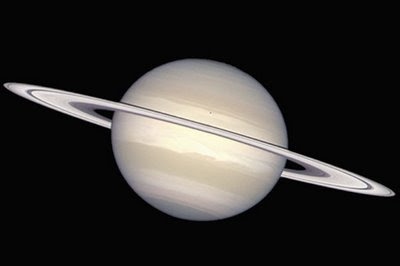
Most observers start out in just about that order, it's a natural progression. Once they've learned their way around the sky and can name many of the bright stars and constellations they gravitate towards the Moon and planets. For many of us, that first magical look through a telescope at Saturn and her majestic ring system is all it takes to get us hooked for life.
Soon after purchasing their first telescope, most amateur astronomers begin seeking out deep sky objects, like the Messier objects. Locating them and learning how to discern the subtle detail available in the eyepiece is a fun and rewarding experience.
Most people find that adding to their understanding of the objects they observe adds to the enjoyment. Knowing that the planetary nebula you are looking is the gaseous remains of an old stars atmosphere, glowing in space due to the energy released by the white dwarf in its center makes them even more exciting to observe. Soon, reading astronomy books and magazines, even astronomy blogs!, becomes a regular activity.
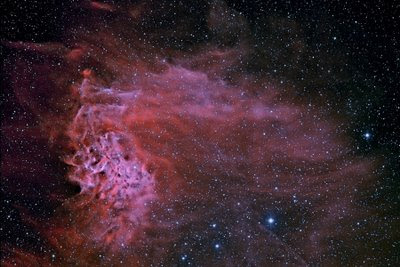 The variable star AE Aurigae is embedded in the Flaming Star Nebula, aka IC 405.
Photo credit: Jorge Garcia, Astronomy Picture of the Day
For me, it was the things that changed from day to day, or even in the course of a few hours, that were always the most interesting things to observe. Watching sun spots rotate around the solar disk, tracking the changing orientation of the Galilean satellites from night to night, watching a prominent feature on Mars rotate out of sight and watching the Moon pass in front of a bright star or planet has always been the biggest thrill for me. Proof that the Universe was alive with motion and packed with action I could see with my own eyes or in a telescope.
Many amateurs can continue on chasing after ever fainter, more elusive 'faint fuzzies', or spend the rest of their life perfecting the technique of obtaining the perfect image of a galaxy or star cluster, but for some, they reach a fork in the road, where they decide they want to actually contribute to science in some meaningful way. For many of these amateur scientists, variable star observing (VSO) provides the answer.
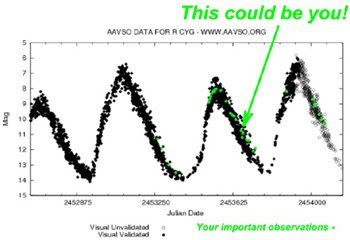
Getting started in VSO presents many of the same challenges as starting out in general astronomy. You need to be able to find your way around the sky, learn the terminology, and learn how to get the most out of your equipment and what the limitations are. And just like other astronomical pursuits, its a lot more fun if you understand what it is you're looking at and why it is interesting to professional astroomers.
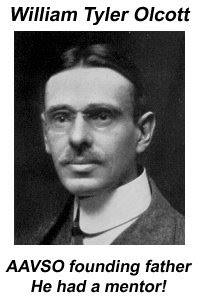
Fortunately, the AAVSO has a program for beginning observers, the AAVSO Mentor Program. The AAVSO has a long tradition of experienced observers helping new observers learn the ropes of VSO. Many of us can trace our knowledge back several generations to some of the most prolific and famous amateur observers of all time. Even William Tyler Olcott, the founder of the AAVSO, started out by learning VSO from another observer.
The mentor program has volunteer instructors in the US, Canada, Europe, South America and Australia. There are mentors for visual observers just stating out and knowledgeable amateurs who can teach you to use a CCD or photoelectric photometer.
"...it is a fact that only by the observation of variable stars can the amateur turn his modest equipment to practical use, and further to any extent the pursuit of knowledge in its application to the noblest of sciences."
William Tyler Olcott, March 1911
If you'd like to turn your modest equipment to practical use observing variable stars, and want to get off to a good start, contact the AAVSO, or email me at mikesimonsen at aavso dot org to request a mentor to help get you started.
Most observers start out doing VSO because they want to contribute to science. The observers who stay with it for years and years do it because its a lot of fun. So come on and join in the fun, but be forewarned, you may get hooked...
Most observers start out in just about that order, it's a natural progression. Once they've learned their way around the sky and can name many of the bright stars and constellations they gravitate towards the Moon and planets. For many of us, that first magical look through a telescope at Saturn and her majestic ring system is all it takes to get us hooked for life.

Soon after purchasing their first telescope, most amateur astronomers begin seeking out deep sky objects, like the Messier objects. Locating them and learning how to discern the subtle detail available in the eyepiece is a fun and rewarding experience.
Most people find that adding to their understanding of the objects they observe adds to the enjoyment. Knowing that the planetary nebula you are looking is the gaseous remains of an old stars atmosphere, glowing in space due to the energy released by the white dwarf in its center makes them even more exciting to observe. Soon, reading astronomy books and magazines, even astronomy blogs!, becomes a regular activity.
 The variable star AE Aurigae is embedded in the Flaming Star Nebula, aka IC 405.
Photo credit: Jorge Garcia, Astronomy Picture of the Day
For me, it was the things that changed from day to day, or even in the course of a few hours, that were always the most interesting things to observe. Watching sun spots rotate around the solar disk, tracking the changing orientation of the Galilean satellites from night to night, watching a prominent feature on Mars rotate out of sight and watching the Moon pass in front of a bright star or planet has always been the biggest thrill for me. Proof that the Universe was alive with motion and packed with action I could see with my own eyes or in a telescope.
Many amateurs can continue on chasing after ever fainter, more elusive 'faint fuzzies', or spend the rest of their life perfecting the technique of obtaining the perfect image of a galaxy or star cluster, but for some, they reach a fork in the road, where they decide they want to actually contribute to science in some meaningful way. For many of these amateur scientists, variable star observing (VSO) provides the answer.

Getting started in VSO presents many of the same challenges as starting out in general astronomy. You need to be able to find your way around the sky, learn the terminology, and learn how to get the most out of your equipment and what the limitations are. And just like other astronomical pursuits, its a lot more fun if you understand what it is you're looking at and why it is interesting to professional astroomers.
Fortunately, the AAVSO has a program for beginning observers, the AAVSO Mentor Program. The AAVSO has a long tradition of experienced observers helping new observers learn the ropes of VSO. Many of us can trace our knowledge back several generations to some of the most prolific and famous amateur observers of all time. Even William Tyler Olcott, the founder of the AAVSO, started out by learning VSO from another observer.

The mentor program has volunteer instructors in the US, Canada, Europe, South America and Australia. There are mentors for visual observers just stating out and knowledgeable amateurs who can teach you to use a CCD or photoelectric photometer.
"...it is a fact that only by the observation of variable stars can the amateur turn his modest equipment to practical use, and further to any extent the pursuit of knowledge in its application to the noblest of sciences."
William Tyler Olcott, March 1911
If you'd like to turn your modest equipment to practical use observing variable stars, and want to get off to a good start, contact the AAVSO, or email me at mikesimonsen at aavso dot org to request a mentor to help get you started.
Most observers start out doing VSO because they want to contribute to science. The observers who stay with it for years and years do it because its a lot of fun. So come on and join in the fun, but be forewarned, you may get hooked...
"I feel it my duty to warn any others who may show signs of star susceptibility that they approach the observing of variable stars with the utmost caution. It is easy to become an addict and, as usual, the longer the indulgence is continued the more difficult it becomes to make a clean break and go back to a normal life."
Leslie C. Peltier, Starlight Nights, 1965
Don’t Lick the Telescope, and Other Tips for Cold Weather Observing
December marks the transition here in Michigan from cool fall weather to downright frigid winter temperatures. For most of January, February and March, there is snow on the ground and the daytime temperatures will hover around freezing. Nighttime temperatures will be well below freezing, and on those few precious clear winter nights it can be unbelievably cold.

Here are some cold weather survival tips I have learned, observing from Michigan in temperatures down to 20 below zero Fahrenheit.
1. Wear warm boots. When I meet people new to astronomy, they always want to know what the best telescope is and what accessories to buy. I always tell them, "The most important piece of equipment you will ever buy is warm boots". When it is clear, it is cold. If your feet are cold, you are miserable. If you are miserable, you are done.
Standing on the cold, damp ground outside you’ll soon know if your boots are up to the task. If they absorb moisture, or don’t insulate you from the cold ground your toes will be crying Uncle long before your favorite Messier object clears the trees.
2. Always dress for temperatures 20 degrees colder than you predict it will be each night.
For the most part, you are not moving around a lot when looking through a telescope, downloading images from your camera or monitoring your tracking. You don’t generate any heat of your own just sitting there, and the night air has a way of sucking the warmth out of you faster than you think it will.
3. Wear a hat. Most of the heat in your body escapes through the top of your head like a chimney. Cover your head and retain body heat.
I’ve seen lots of funky looking hats at star parties. Don’t worry about fashion. Go for comfort. My deep-winter, arctic-air-repelling hat is a big leather and fur job with earflaps and a long extension in back that covers my neck. I look like one of the wicked witch of the North’s soldiers in my long coat and that hat, but I’m warm.
4. Keep your hands warm. Mittens are better than gloves, but they are awkward to use when dealing with focuser knobs, charts, pens and pencils, But if you can keep your fingers together, tucked away from the cold, they fare much better than they do as individual digits exposed to the elements. I’ve never had much luck with those gloves with the flip-top mitten cover for your fingers.
If you insist on wearing gloves, like I do, keep your hands in your pockets and out of the wind, as much as you can. Those little chemical heat packs you can buy in sporting goods stores work pretty well for a while. I sometimes throw a couple in my coat packets to create a safe haven for my fingers for a few moments between variable star observations.
If your fingers begin to hurt from the cold, go inside or get in your car and warm them up thoroughly. Frostbite can be very painful.
5. Get out of the wind. Most of the time it’s not the air temperature that gets you, it’s the wind-chill. Put a building or a hedge, or better yet, an observatory, between you and the wind and you will be able to endure the cold for twice as long. The added bonus, of not having the telescope shake in the breeze, will save you time in making critical observations.
I remember very well the night that convinced me to build an observatory. It took twice as long as usual to set up wearing gloves, I dropped a small wrench in the snow and spent half an hour looking for it, the telescope was shaking so much it was hard to see anything in the eyepiece, my eyes kept tearing up from the wind and dropping tears onto the eyepiece lens, and the wind kept blowing right up my back as I faced south trying in vain to make variable star estimates.
I spent three hours out in the snow and wind and got exactly one variable star estimate that night. That week I became the proud owner of a fiberglass, domed observatory.
6. Don’t breathe on optics. Breathing on cold glass means instant frost. If you wear a scarf over your face, be sure not to let the warm air you exhale spill out over the top of the scarf and down onto the eyepiece.
Set up your finder-scope so you are not breathing on the eyepiece when looking through the finder. On very cold nights, I sometimes have a large patch of frost on the back of the mirror cell of my Schmidt-Cassegrain, caused from my breath freezing on the back of the telescope while looking through the finder-scope.
7. If you have dew heaters, use them right from the start of your session. They are much better at preventing frosted corrector plates, secondaries, eyepieces and finders than they are at removing frost. If you don’t have dew heaters, get them.
A heated box or holder for eyepieces can be a great benefit. If you only switch between a few, keep them in your pockets to stay warm.
Another accessory I find handy is a small hair dryer. If you have electricity available, one of these can be great to warm the eyepiece up enough to prevent fogging. If the lens or corrector plate on your telescope frosts up, you can use it to carefully remove the dew or frost.
You can also use it to warm your fingers. I’ve even stuck mine inside my coat to warm my frozen torso enough to go a little while longer. I’m sure this is a fire hazard, and you’ll probably read in the paper one day, “Michigan astronomer mysteriously ignites into flames, burning down observatory.”
8. If you take notes at the telescope like I do, keep your pen warm or the ink will freeze. I have one of those "astronaut pens". Even that froze at 20 below.
I keep my pens tucked behind my ear to keep them warm. All my observing hats have a distinct black ink spot on the inside lining, just behind my left ear, from me continuously sliding my pen in and out under my cap and over my ear for warm storage.
9. Use a plastic flashlight. If you are like most of my friends who read charts and log observations using a red flashlight, you put the flashlight in your mouth to write. On very cold nights, a metal flashlight can stick to your lip and be hard to remove without losing a bit of flesh.
Don’t laugh; I’ve seen it happen!
I suppose rule 9A should be, "don’t lick the telescope!"
If I ever see anyone get his or her tongue stuck to a frozen telescope, you’ll be the first to know!
10. Take breaks every hour or half hour, depending on the weather, and go warm up. Keep an extra pair of dry socks warming on the dash of your car, or go in and throw a pair in the dryer for a few minutes. It’s amazing how a nice toasty pair of socks can change your attitude!
I’ve received several pairs of electric socks for Christmas and birthdays over the years from well-meaning friends and family, but I’ve never been really impressed by them. Considering the number of batteries it takes to actually keep your feet warm, it’s just not worth it. Refer to rule #1. Wear warm boots.
11. Be aware of battery life in cold temperatures. The batteries in your flashlight, telescope, camera, dew heaters, etc., will perform poorly in cold temperatures. They’re smarter than me. They know when to quit. Keep warm extras handy.
12. Keep your own personal battery charged. Plenty of rest, a good meal, snacks and hot coffee go a long way towards warding off the inevitable freeze.
The search for a thermos that would keep coffee hot in sub-zero temperatures was my ‘Holy Grail’ for a long time. After years of searching, I finally found one at a camping supply store. It cost a pretty penny, but it makes all the difference to me.
13. Know your limits. You have to be realistic about how much cold, discomfort or pain you are willing endure in order to get those last few observations. Don’t wait until it’s too late and then decide to tear down and pack up.
When you are really frozen, you fingers don’t work right, you move slower, you feel more tired than you normally would, and you can get careless, dropping things in the dark or forgetting how to pack your gear just so. All this means it is going to take you longer than usual to tear down.
That’s when you will meet Mr. Frostbite. It is better to take my word for it than to learn a painful lesson from him.
With a little planning and common sense you can take advantage of those long, clear, cold winter nights. Orion, Gemini and Taurus are calling. Just be careful out there.

1. Wear warm boots. When I meet people new to astronomy, they always want to know what the best telescope is and what accessories to buy. I always tell them, "The most important piece of equipment you will ever buy is warm boots". When it is clear, it is cold. If your feet are cold, you are miserable. If you are miserable, you are done.
Standing on the cold, damp ground outside you’ll soon know if your boots are up to the task. If they absorb moisture, or don’t insulate you from the cold ground your toes will be crying Uncle long before your favorite Messier object clears the trees.
2. Always dress for temperatures 20 degrees colder than you predict it will be each night.
For the most part, you are not moving around a lot when looking through a telescope, downloading images from your camera or monitoring your tracking. You don’t generate any heat of your own just sitting there, and the night air has a way of sucking the warmth out of you faster than you think it will.
3. Wear a hat. Most of the heat in your body escapes through the top of your head like a chimney. Cover your head and retain body heat.
I’ve seen lots of funky looking hats at star parties. Don’t worry about fashion. Go for comfort. My deep-winter, arctic-air-repelling hat is a big leather and fur job with earflaps and a long extension in back that covers my neck. I look like one of the wicked witch of the North’s soldiers in my long coat and that hat, but I’m warm.
4. Keep your hands warm. Mittens are better than gloves, but they are awkward to use when dealing with focuser knobs, charts, pens and pencils, But if you can keep your fingers together, tucked away from the cold, they fare much better than they do as individual digits exposed to the elements. I’ve never had much luck with those gloves with the flip-top mitten cover for your fingers.
If you insist on wearing gloves, like I do, keep your hands in your pockets and out of the wind, as much as you can. Those little chemical heat packs you can buy in sporting goods stores work pretty well for a while. I sometimes throw a couple in my coat packets to create a safe haven for my fingers for a few moments between variable star observations.
If your fingers begin to hurt from the cold, go inside or get in your car and warm them up thoroughly. Frostbite can be very painful.
5. Get out of the wind. Most of the time it’s not the air temperature that gets you, it’s the wind-chill. Put a building or a hedge, or better yet, an observatory, between you and the wind and you will be able to endure the cold for twice as long. The added bonus, of not having the telescope shake in the breeze, will save you time in making critical observations.
I remember very well the night that convinced me to build an observatory. It took twice as long as usual to set up wearing gloves, I dropped a small wrench in the snow and spent half an hour looking for it, the telescope was shaking so much it was hard to see anything in the eyepiece, my eyes kept tearing up from the wind and dropping tears onto the eyepiece lens, and the wind kept blowing right up my back as I faced south trying in vain to make variable star estimates.
I spent three hours out in the snow and wind and got exactly one variable star estimate that night. That week I became the proud owner of a fiberglass, domed observatory.
6. Don’t breathe on optics. Breathing on cold glass means instant frost. If you wear a scarf over your face, be sure not to let the warm air you exhale spill out over the top of the scarf and down onto the eyepiece.
Set up your finder-scope so you are not breathing on the eyepiece when looking through the finder. On very cold nights, I sometimes have a large patch of frost on the back of the mirror cell of my Schmidt-Cassegrain, caused from my breath freezing on the back of the telescope while looking through the finder-scope.
7. If you have dew heaters, use them right from the start of your session. They are much better at preventing frosted corrector plates, secondaries, eyepieces and finders than they are at removing frost. If you don’t have dew heaters, get them.
A heated box or holder for eyepieces can be a great benefit. If you only switch between a few, keep them in your pockets to stay warm.
Another accessory I find handy is a small hair dryer. If you have electricity available, one of these can be great to warm the eyepiece up enough to prevent fogging. If the lens or corrector plate on your telescope frosts up, you can use it to carefully remove the dew or frost.
You can also use it to warm your fingers. I’ve even stuck mine inside my coat to warm my frozen torso enough to go a little while longer. I’m sure this is a fire hazard, and you’ll probably read in the paper one day, “Michigan astronomer mysteriously ignites into flames, burning down observatory.”
8. If you take notes at the telescope like I do, keep your pen warm or the ink will freeze. I have one of those "astronaut pens". Even that froze at 20 below.
I keep my pens tucked behind my ear to keep them warm. All my observing hats have a distinct black ink spot on the inside lining, just behind my left ear, from me continuously sliding my pen in and out under my cap and over my ear for warm storage.
9. Use a plastic flashlight. If you are like most of my friends who read charts and log observations using a red flashlight, you put the flashlight in your mouth to write. On very cold nights, a metal flashlight can stick to your lip and be hard to remove without losing a bit of flesh.
Don’t laugh; I’ve seen it happen!
I suppose rule 9A should be, "don’t lick the telescope!"
If I ever see anyone get his or her tongue stuck to a frozen telescope, you’ll be the first to know!
10. Take breaks every hour or half hour, depending on the weather, and go warm up. Keep an extra pair of dry socks warming on the dash of your car, or go in and throw a pair in the dryer for a few minutes. It’s amazing how a nice toasty pair of socks can change your attitude!
I’ve received several pairs of electric socks for Christmas and birthdays over the years from well-meaning friends and family, but I’ve never been really impressed by them. Considering the number of batteries it takes to actually keep your feet warm, it’s just not worth it. Refer to rule #1. Wear warm boots.
11. Be aware of battery life in cold temperatures. The batteries in your flashlight, telescope, camera, dew heaters, etc., will perform poorly in cold temperatures. They’re smarter than me. They know when to quit. Keep warm extras handy.
12. Keep your own personal battery charged. Plenty of rest, a good meal, snacks and hot coffee go a long way towards warding off the inevitable freeze.
The search for a thermos that would keep coffee hot in sub-zero temperatures was my ‘Holy Grail’ for a long time. After years of searching, I finally found one at a camping supply store. It cost a pretty penny, but it makes all the difference to me.
13. Know your limits. You have to be realistic about how much cold, discomfort or pain you are willing endure in order to get those last few observations. Don’t wait until it’s too late and then decide to tear down and pack up.
When you are really frozen, you fingers don’t work right, you move slower, you feel more tired than you normally would, and you can get careless, dropping things in the dark or forgetting how to pack your gear just so. All this means it is going to take you longer than usual to tear down.
That’s when you will meet Mr. Frostbite. It is better to take my word for it than to learn a painful lesson from him.
With a little planning and common sense you can take advantage of those long, clear, cold winter nights. Orion, Gemini and Taurus are calling. Just be careful out there.
Eta Carinae- A Naked Eye Enigma

Credit: X-ray: NASA/CXC/GSFC/M.Corcoran et al.; Optical: NASA/STScI
Eta Carinae is a beast of a star. At more than 100 solar masses and 4 million times the luminosity of our Sun, eta Car balances dangerously on the edge of stellar stability and it’s ultimate fate: complete self-destruction as a supernova. Recently, Hubble Space Telescope observations of the central star in the eta Carinae Nebula have raised an alert on eta Car among the professional community.
What they discovered was totally unexpected. “It used to be, that if you looked at eta Car you saw a nebula and then a faint little core in the middle” said Dr. Kris Davidson, from the University of Minnesota. “Now when you look at it, it’s basically the star with a nebula. The appearance is completely different. The light from the star now accounts for more than half the total output of eta Car. I didn’t expect that to happen until the middle of this century. It’s decades ahead of schedule. We know so little about these very massive objects, that if eta Car becomes a supernova next Thursday we should not be very surprised.”
In 1843, eta Carinae underwent a spectacular eruption, making it the second brightest star in the sky behind Sirius. During this violent episode, eta Car ejected 2 to 3 solar masses of material from the star’s polar regions. This material, traveling at speeds close to 700 km/s, formed two large, bipolar lobes, now known as the Homunculus Nebula. After the great eruption, Eta Car faded, erupted again briefly fifty years later, then settled down, around 8th magnitude. Davidson picks up the story from there.

This light curve depicts the visual apparent brightness of Eta Car from 1822 to date. It contains visual estimates (big circles), photographic (squares), photoelectric (triangles) and CCD (small circles) observations.
All of them have been fitted for consistency of the whole data. Red points are recent observations from La Plata (Feinstein 1967; Fernández-Lajús et al., 2009, 2010). Used by permission.
“Around 1940, Eta suddenly changed its state. The spectrum changed and the brightness started to increase. Unfortunately, all this happened at a time when almost no one was looking at it. So we don’t know exactly what happened. All we know is that by the 1950’s, the spectrum had high excitation Helium lines in it that it didn’t have before, and the whole object, the star plus the Homunculus, was gradually increasing in brightness. In the past we’ve seen three changes of state. I suspect we are seeing another one happening now.”
During this whole time eta Car has been shedding material via its ferocious stellar winds. This has resulted in an opaque cloud of dust in the immediate vicinity of the star. Normally, this much dust would block our view to the star. So how does Davidson explain this recent, sudden increase in the luminosity of eta Carinae?
“The direct brightening we see is probably the dust being cleared away, but it can’t be merely the expansion of the dust. If it’s clearing away that fast, either something is destroying the dust, or the stellar wind is not producing as much dust as it did before. Personally, I think the stellar wind is decreasing, and the star is returning to the state it was in more than three hundred years ago. In the 1670’s, it was a fourth magnitude, blue, hot star. I think it is returning to that state. Eta Carinae has just taken this long to readjust from its explosion in the 1840’s.”
After 150 years what do we really know about one of the great mysteries of stellar physics? “We don’t understand it, and don’t believe anyone who says they do,” said Davidson. “The problem is we don’t have a real honest-to-God model, and one of the reasons for that is we don’t have a real honest-to-God explanation of what happened in 1843.”
Can amateur astronomers with modest equipment help untangle the mysteries of eta Carinae? Davidson think so, “The main thing is to make sure everyone in the southern hemisphere knows about it, and anyone with a telescope, CCD or spectrograph should have it pointed at eta Carinae every clear night.”
Subscribe to:
Posts (Atom)