Cataclysmic variable star research has benefited from the, often accidental, discovery of CVs during the course of astronomers doing other research. This has led to a lot of license plate type names like RSXJ01234.45+2345.6, HS 1234+5678 and PG 1234+67. These are prefix based names that indicate the space satellite or ground survey that discovered the star. RSX means it was a ROSAT satellite x-ray source, HS stands for the Hamburg Quasar Survey, and PG means it was discovered by the Palomar Green Survey (also looking for quasars). For more information on this plethora of naming conventions see my article "What's In A Name?"
Serendipity comes into play because all of these previously mentioned examples are stars discovered by surveys looking for other types of objects. ROSAT was looking for x-ray sources on the sky and the Palomar and Hamburg surveys were looking for blue objects in their search for quasars. The most common way CVs are discovered from these population of objects is by going into outburst and revealing themselves as much brighter in new images compared to older images. Until recently, it would be safe to say half of all CVs were discovered by their telltale outbursts or optical variability when active or bright.
Today a paper was published on ArXiv describing a new CV, RAT J1943+1859, discovered while astronomers were looking for variable stars in the field of the globular cluster M71. RAT stands for RApid Temporal Survey, an experiment utilizing the Isaac Newton Telescope. Even though the astronomers were actually looking for variable stars this time, what they didn't expect to find were stars exhibiting quasi-periodic oscillations (QPOs), a little understood phenomena of cataclysmic variables, while the CVs are in quiescence (faint).
That is exactly what happened in this case. Astronomers found a periodic oscillation of about 0.3 magnitudes with a period of approximately 20 minutes. Observations taken later with another telescope revealed the object to be four magnitudes brighter than the first set of observations. They caught it in outburst! Further observations and spectroscopy suggest an orbital period of about 90 minutes, which means it is very likely to be a UGSU type dwarf nova at a distance of about 1.5 kiloparsecs. If this distance is accurate, RAT J1943+1859 is one of the most luminous sources observed by ROSAT.
So far, observations have measured the system at minimum around 20th magnitude, and in outburst approximately 16.5V. If it is a UGSU it will have superoutbursts somewhat brighter than this that will last longer, perhaps a couple weeks. This puts it right around the faint limit for 30cm amateur telescopes to study in outburst to determine its type, orbital period and superhump period if it goes into a superoutburst.
Even more exciting than the fact this might be another interesting system for amateurs to monitor, is the fact that RATS has several million light curves in their data that can now be searched for this same kind of behavior. These astronomers may have discovered a new way to discover CVs! This also has implications as more surveys like LSST and PanSTARRS are readying to come online in the near future. Scientists will be developing ways to sort out specific kinds of stars from the terabytes of data these surveys will create every night.
In that new era, amateurs will be needed more than ever to sift through the strange and unique discoveries these surveys stumble on while monitoring the cosmos every night in unprecendented detail.
RATS, QPOs, serendipity and discovery. It's a new age already.


Carnival of Space Milestone
 The Carnival of Space, brought to you by Fraser Cain of Universe Today, has reached a milestone. Today's carnival is the 100th weekly collection of astronomy and space science blogs.
This week's host is the One Minute Astronomer. The philosophy behind One-Minute Astronomer is simple: to help you build your knowledge and appreciation of astronomy, one small step at a time. The One Minute Astronomer blog features short articles on all aspects of astronomy.
Simostronomy will be back on a regular basis soon. The storms that keep knocking us back into the Stone Age should stop any day now. We've got some interesting stars to talk about and will be blogging from the SAS/AAVSO joint meeting in Big Bear, CA in May.
Interesting Outburst Update
The weather cooperated nicely Friday into Saturday morning and I was able to collect data on two eclipses of IY UMa. This light curve looks a lot better than the last one. The errors are small and this covers two cycles and two eclipses in pretty good detail.
 Pretty schweet, huh?
Click to enlarge
 Pretty schweet, huh?
Interesting Outburst
A couple nights ago IY Ursa Majoris (IY UMa) went into outburst. This is one of those rare eclipsing CVs that astronomers really like to get data on, because with an eclipse you can tell the period of the system as the components orbit around each other.
In a CV binary, one star is a white dwarf: a collapsed star of approximately one solar mass in the volume of the Earth. The other star is a red dwarf rather like our Sun, but redder and less massive.
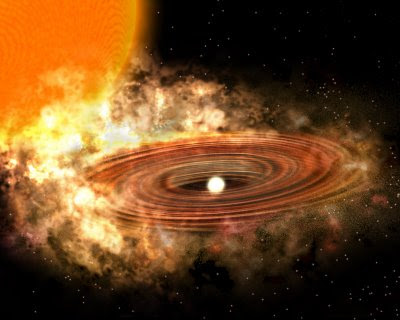
The red dwarf and the white dwarf orbit each other once every few hours: they are so close together that the average CV system would fit comfortably into our Sun. The red star in a CV is so close to the white dwarf that it becomes tidally distorted --- gas is stripped off the red star and falls towards the white dwarf. The infalling gas forms a disc -- an accretion disc -- with the white dwarf at its center. The gas in the disc spirals down towards the white dwarf, radiating its gravitational potential energy away as it goes. The accretion disc usually outshines both the red star and the white dwarf in visible light.
When these systems go into outburst it is the material in the accretion disk falling onto the white dwarf and burning off in a giant explosion that we see as a brightening of the system. In some cases, the white dwarf and the red dwarf line up more or less to our line of sight, and as one passes in front of the other we see it dim as it is eclipsed. The disk can be eclipsed, the hot spot can be eclipsed, the white dwarf may be eclipsed, and from all these clues we can figure out a lot about these CVs.
In order to get a firm handle on the period, it is best to observe and record at least two eclipses, if not more. Most CVs I monitor have orbital periods of anywhere from 90 mimutes to 3 hours. That means you need somewhere between 3 hours and 7 hours of clear weather to have a good run.
The weather forecast was promising for Monday, so I got out and tried to grab an eclipse observation with the 12" LX200 and CCD camera. Below are my results. You can click on the image to see it up close.
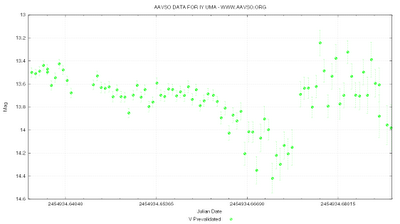 As you can see, I only got one eclipse, but it is pretty easy to see in this light curve. You can also see the affects of incoming clouds on the quality of my observations as the data gets noisier and noisier as the system was coming out of eclipse. When the error bars grew to 0.2 magnitudes I was shooting through thin clouds.
With a little luck, I'll get two eclipses tonight.
In a CV binary, one star is a white dwarf: a collapsed star of approximately one solar mass in the volume of the Earth. The other star is a red dwarf rather like our Sun, but redder and less massive.

The red dwarf and the white dwarf orbit each other once every few hours: they are so close together that the average CV system would fit comfortably into our Sun. The red star in a CV is so close to the white dwarf that it becomes tidally distorted --- gas is stripped off the red star and falls towards the white dwarf. The infalling gas forms a disc -- an accretion disc -- with the white dwarf at its center. The gas in the disc spirals down towards the white dwarf, radiating its gravitational potential energy away as it goes. The accretion disc usually outshines both the red star and the white dwarf in visible light.
When these systems go into outburst it is the material in the accretion disk falling onto the white dwarf and burning off in a giant explosion that we see as a brightening of the system. In some cases, the white dwarf and the red dwarf line up more or less to our line of sight, and as one passes in front of the other we see it dim as it is eclipsed. The disk can be eclipsed, the hot spot can be eclipsed, the white dwarf may be eclipsed, and from all these clues we can figure out a lot about these CVs.
In order to get a firm handle on the period, it is best to observe and record at least two eclipses, if not more. Most CVs I monitor have orbital periods of anywhere from 90 mimutes to 3 hours. That means you need somewhere between 3 hours and 7 hours of clear weather to have a good run.
The weather forecast was promising for Monday, so I got out and tried to grab an eclipse observation with the 12" LX200 and CCD camera. Below are my results. You can click on the image to see it up close.
 As you can see, I only got one eclipse, but it is pretty easy to see in this light curve. You can also see the affects of incoming clouds on the quality of my observations as the data gets noisier and noisier as the system was coming out of eclipse. When the error bars grew to 0.2 magnitudes I was shooting through thin clouds.
With a little luck, I'll get two eclipses tonight.
Simostronomy on Slacker Astronomy pt. 2
It took us a while, but the second part of my discussion with Michael and Doug on Slacker Astronomy is now online.
You can download the podcast here.
 In this episode, we talk about where research in cataclysmic variables is going, what astronomers are expecting to find and some of the surprises we've found along the way. I was fortunate to get three astronomers from the Wild Stars in the Old West II conference, Christopher Tout, Paula Szkody and Boris Gaensicke, to give up their coffee break time to let me interview them for this show.
My thanks to Michael and Doug for having me on the show, and to Paula, Christopher and Boris for giving me something interesting to contribute.

 Boris Gaensicke / Christopher Tout /Paula Szkody
So check it out:
You can download the podcast here.
 In this episode, we talk about where research in cataclysmic variables is going, what astronomers are expecting to find and some of the surprises we've found along the way. I was fortunate to get three astronomers from the Wild Stars in the Old West II conference, Christopher Tout, Paula Szkody and Boris Gaensicke, to give up their coffee break time to let me interview them for this show.
My thanks to Michael and Doug for having me on the show, and to Paula, Christopher and Boris for giving me something interesting to contribute.

 Boris Gaensicke / Christopher Tout /Paula Szkody
 So check it out:
Podcast: Simo-Slacker Interviews Pt. II
Can Visual Astronomers Still Contribute to Science?
Today's episode of the 365 Days of Astronomy Podcast examines the controversial issue of the scientific value of visual observations.
Entitled Can Visual Observers Still Contribute to Science? we examine the consequences of living in an age with CCDs and automated sky surveys, and the impact they are having on visual variable star observers.

Restless Universe is the podcast of the American Association of Variable Star Observers (AAVSO).
Entitled Can Visual Observers Still Contribute to Science? we examine the consequences of living in an age with CCDs and automated sky surveys, and the impact they are having on visual variable star observers.

Restless Universe is the podcast of the American Association of Variable Star Observers (AAVSO).
Carnival of Space #97
Carnival of Space #97 has been done on a shoestring budget over at the Cheap Astronomy blog site.
Cheap Astronomy is a site all about exploring the universe with your eyes, a pair of binoculars or one of those out-of-the box department store telescopes. Everything on the site is aimed at people who want to do real astronomy for $300 or less.

The contributions to this week's carnival feature Mars quite a bit. There are also some fascinating pieces on space telescopes, Titan, the space station and space shuttle. The Simostronomy contribution this week is the interview with Martin Ratcliffe.
Enjoy the ride. Admission is free. It doesn't get any cheaper than that!
Cheap Astronomy is a site all about exploring the universe with your eyes, a pair of binoculars or one of those out-of-the box department store telescopes. Everything on the site is aimed at people who want to do real astronomy for $300 or less.

The contributions to this week's carnival feature Mars quite a bit. There are also some fascinating pieces on space telescopes, Titan, the space station and space shuttle. The Simostronomy contribution this week is the interview with Martin Ratcliffe.
Enjoy the ride. Admission is free. It doesn't get any cheaper than that!
Simo Slacker!
As promised, the interviews I did with five astronomers at the Wild Stars in the Old West II conference are now coming online, thanks to my friends at Slacker Astronomy, Michael Koppelman and Doug Welch. The first part of the series is now available.
The first interview in this episode is with Brad Schaefer from LSU. Brad is very excited about the results of his research on recurrent novae. These cataclysmic variables grab our attention and spark our imaginations because of the incredible amplitude of their outbursts, typically 8-12 magnitudes, and the rarity of these spectacular events. Many of these outbursts are once-in-a-lifetime events. Like an apparition of Halley's comet, witnessing an outburst of T CrB twice in a lifetime would be a matter of uncommon luck, longevity or both.
 Artist's depiction of the recurrent nova, RS Ophiuchi, in outburst.
(Illustration Credit & Copyright: David A. Hardy & PPARC; Astronomy Picture of the Day 2006 July 26).
I've written about recurrent novae before. The cause of a nova eruption is a thermonuclear reaction on the surface of the white dwarf. After years of mass exchange between the binary pair, temperature and pressure at the surface of the white dwarf build sufficiently to cause the layer of accreted material to explode like a hydrogen bomb. This bomb, however, can have the mass of 30 Earths! Once the temperature becomes high enough, this layer begins to expand. Minutes into the process the shell can be radiating at 100,000 solar luminosities and expanding outwards at 3000 km/s. Eventually the shell envelopes the entire binary and the orbital motion of the pair acts like a propeller to whip things up. After 1000 days or so the envelope expands to the point it can be seen as nebulosity surrounding the pair. Over hundreds of years the shell dissipates into the interstellar medium.
Most novae probably erupt more than once in their lifetime, with the mass of the white dwarf determining the amount of accreted material that needs to accumulate before triggering on outburst. Systems with a white dwarf of 0.6 solar masses might take as long as 5 million years between eruptions. A system with a 1.3 solar mass white dwarf might only take 30,000 years between eruptions. Systems with recurrence times of 100 years or less probably have very massive white dwarf primaries.
With so few known examples and the rarity of these events it is no wonder that recurrent novae eruptions are extremely interesting to astronomers. Monitoring these stars for outbursts over decades of relative inactivity is still one of the extremely valuable contributions visual observers can provide to science.
The second interview is with Steve Howell, of NOAO. Steve and I talked about the advances that have been made in CV research since the last Wild Stars meeting ten years ago. I also asked him where he thinks new research is heading.
But, I have to admit, I really wanted to talk to him about his awesome image of magnetic accretion. I saw this in his poster presentation at the meeting and was blown away by the whole concept of the complicated, beautiful way mass is accreted in polars.
 Image credit: S. Howell / P. Marenfeld/NOAO
The first interview in this episode is with Brad Schaefer from LSU. Brad is very excited about the results of his research on recurrent novae. These cataclysmic variables grab our attention and spark our imaginations because of the incredible amplitude of their outbursts, typically 8-12 magnitudes, and the rarity of these spectacular events. Many of these outbursts are once-in-a-lifetime events. Like an apparition of Halley's comet, witnessing an outburst of T CrB twice in a lifetime would be a matter of uncommon luck, longevity or both.
 Artist's depiction of the recurrent nova, RS Ophiuchi, in outburst.
(Illustration Credit & Copyright: David A. Hardy & PPARC; Astronomy Picture of the Day 2006 July 26).
I've written about recurrent novae before. The cause of a nova eruption is a thermonuclear reaction on the surface of the white dwarf. After years of mass exchange between the binary pair, temperature and pressure at the surface of the white dwarf build sufficiently to cause the layer of accreted material to explode like a hydrogen bomb. This bomb, however, can have the mass of 30 Earths! Once the temperature becomes high enough, this layer begins to expand. Minutes into the process the shell can be radiating at 100,000 solar luminosities and expanding outwards at 3000 km/s. Eventually the shell envelopes the entire binary and the orbital motion of the pair acts like a propeller to whip things up. After 1000 days or so the envelope expands to the point it can be seen as nebulosity surrounding the pair. Over hundreds of years the shell dissipates into the interstellar medium.
Most novae probably erupt more than once in their lifetime, with the mass of the white dwarf determining the amount of accreted material that needs to accumulate before triggering on outburst. Systems with a white dwarf of 0.6 solar masses might take as long as 5 million years between eruptions. A system with a 1.3 solar mass white dwarf might only take 30,000 years between eruptions. Systems with recurrence times of 100 years or less probably have very massive white dwarf primaries.
With so few known examples and the rarity of these events it is no wonder that recurrent novae eruptions are extremely interesting to astronomers. Monitoring these stars for outbursts over decades of relative inactivity is still one of the extremely valuable contributions visual observers can provide to science.
The second interview is with Steve Howell, of NOAO. Steve and I talked about the advances that have been made in CV research since the last Wild Stars meeting ten years ago. I also asked him where he thinks new research is heading.
But, I have to admit, I really wanted to talk to him about his awesome image of magnetic accretion. I saw this in his poster presentation at the meeting and was blown away by the whole concept of the complicated, beautiful way mass is accreted in polars.
 Image credit: S. Howell / P. Marenfeld/NOAO
I hope you enjoy the podcast. My sincere thanks to Michael, Doug, Brad and Steve for making these Simo-interviews possible.
Subscribe to:
Posts (Atom)