Carnival of Space

For those of you who happened here by happy chance, you may not know about the Carnival of Space. It is a weekly collection of many of the best astronomy bloggers articles pulled together in one place for you to peruse.

Each week it is hosted by a different blog, so you get a chance to visit some interesting blogsites and see what they are all about, as well as links to selected articles from the astronomy blogosphere.

For those of you who know all about Carnival of Space, well its back, and this one is a good one. Hosted by Jennifer Ouellette (yea, she's hot) at Twisted Physics, one of my favorite reads, Carnival of Space #72 is live and kicking.

Coyotes and the Dicks Across the Road

We have coyotes around here. That's right, the dog creatures that let out that familiar "ow-ow-owoooo" call in the night. That's not a sound you like to hear break the foggy silence at 1 o'clock in the morning when you're outside, alone in the dark.

For the most part, they stay across the road, living and hunting around the lake where there is plenty of food, water and shelter. Sometimes, they get all riled up for whatever reason, and a whole bunch of them will start yapping and howling. It usually gets all the dogs within earshot going at the same time. It usually raises the hair on my arms and neck too.

A couple times a year, they get chased over to my side of the road when the Dicks across the road have a big party and build a bonfire.

Now let me explain. This is not a derogatory remark. The Dicks are a nice family. That just happens to be their last name.

The old man, grandpa Dick, his name is Donald. That's right, Donald Dick. His son Darrell, his wife and their two kids live nearest the lake. Donald's daughter, Delma, and her girls, live in the house on top of the hill to the northwest part of the property. The family owns all but a small sliver of the shoreline around the lake and most of the adjoining property. The Dicks have been here for decades and everyone knows them.

The coyotes have them figured out too. They know all the game birds and small animals are going to head for shelter as soon as the Dicks set up their party tent and stack up the bonfire wood. So they head for better hunting grounds, which means they scavenge along the tree line of my property and the woods southeast of me.

Usually they are pretty stealthy, but sometimes I can hear them in the horse pasture east of the observatory as they travel across my property in packs in search of prey.

Once I walked out to the dome, armed only with a red flashlight against the darkness of a moonless night, and just as I got to the door of the observatory my flashlight caught the glint of a pair of eyes looking right at me from about twenty feet away. A moment later, another pair of eyes was staring at me, sizing me up for dinner in my mind. I'm not a sissy, but that will dampen your enthusiasm for the cold darkness, no matter how clear the sky is that night.

Every once in a while one will get a little close to the house. A few nights ago, I walked outside and was greeted by a growling voice feet away in the dark. I never saw the beast, he retreated into the trees in a hurry, but I assume it was one of the local coyotes.

This morning I looked out my office window as the sun was coming up and there were two of them just the other side of the fence in the horse pasture. I opened my window to get a better look with binoculars and even that slight noise got their attention. They ran away, which is fine with me.

I don't expect any problem with one or two of them in the night. But I am concerned that one night there may be enough of them together when I step out into the darkness that they will be less afraid than normal.

I hope to peacefully coexist with them for many years to come. Living in the country has its advantages, and I think the wildlife is one of them. But in the darkness I always feel they have the upper hand, and it's a little unnerving.

Grandpa Mike

Irene and I went to dinner last night with my son and our new daughter-in-law. It was Nicole's birthday, but she was the one giving us a gift. We are going to be grandparents in about 7 1/2 months!

Just look at these two. They are gonna make some great looking babies!

We also got the first picture of our new grandchild. See how good looking he is already! He's the little guy attached to the wall of the cavity in the picture below. You can tell he's a boy already. Just look at the size of that thing!


The problem with birds...

The problem with birds isn't the birds, it's me. I love birds. We plant all kinds of trees, flowers and shrubs to encourage birds to visit us year round. I like watching them at the feeders. I marvel at their acrobatic dodging and diving. I like hearing their songs in the morning in spring and summer. I even like the way the turkey vultures around here clean up the road kill. Birds are in a word, amazing.

My problem with birds started years ago when we lived in the suburbs. Our house backed up to a wooded area, and our extensive landscaping kept creeping further and further into the woods as the years went by. At some point, I decided to plant some spruce trees near the cottage garden on the east side of the house. They were lovely trees and every spring the robins would come and settle in our yard by the woods and build their nests in the spruce trees, which offer cover and shelter from the local predators.

Unfortunately, the spruce tress were a little close to the garden beds, and when there were eggs or young in the nests the parent birds would get very protective, and at times, downright aggressive in their protection. They would dive-bomb Irene and I on the weekends as we worked in the garden. They'd come so close to our heads at times, I swore they were gonna collide with us eventually.

I understand what was going on, and I would never disturb or destroy a nest, but to be honest, it pissed me off. We were minding our own business in our garden and they were taking hostile and aggressive actions against us, the people who planted the trees they loved so much. Eventually, I cut down the spruce trees. Problem solved.

Then we moved to the country.

The second summer we lived here, I bought a new garden tractor to cut the grass. I was so proud, cutting my lawn in half the time it took with the old, used beater I had purchased as an afterthought the first year. The lawn looked good and I didn't mind cutting 2.5 acres of grass each week.

Then the barn swallows showed up.

I'll never forget that first time. I was mowing the lawn and a couple barn swallows started swooping in towards me as I criss-crossed the lawn. They got nerve-wrackingly close at times, and I was actually ducking, fearing they were going to collide head on with me as I tooled across the lawn.

The second time it happened, maybe a couple weeks later, I got off the mower and called Irene out to see what was going on. I didn't think it was my imagination, but I was a little sensitive to bird aggression from my previous experience, so I wanted a witness. She was as amazed as I was. There were a half dozen birds swooping and diving and doing acrobatic maneuvers in mid-air, in front of me and right above my head as I rode my tractor across the property.

I couldn't believe my rotten luck. The first thing I did was check all the trees in and around the lawn to see if there were barn swallow nests nearby. Well, barn swallows like barns (doh!) and other man-made structures. So, not surprisingly, I didn't find any nests.

Near the end of that second year I just happened to be wearing my glasses instead of my non-prescription sunglasses while I was out on the mower. The barn swallows showed up again and started in with their acrobatic 'Mike attack'. But this time, to my amazement, I could see clearly what it was they were really up to.

As the tractor plowed through the grass, it stirred up frogs and bugs the whole way across the lawn. I saw a barn swallow dive down and nab a grasshopper in mid-air three feet in front of the tractor. I watched as moths, crickets and other bugs became lunch in the snap of a beak and beat of a wing. Truly amazing to watch...with my glasses on.

Ever since then I've been at peace with the swallows. There is no maliciousness in their little hearts. It is a simple symbiotic relationship they have with me and my tractor. When I go out to mow the lawn I often call back to Irene as I step out the back, "I'm going to feed the birds!"

So what does any of this have to do with astronomy and animals in the dark? I'm getting there. It's one of those deals where I have to tell you a story to tell you a story. Trust me...

This June, we spent a week in the Virgin Islands as my son got married on the beach on St. John. When we came home, we noticed that a pair of barn swallows had begun building one of their ingenious little mud nests on top of one of the drop down blinds we have on the porch. Not wanting to disturb 'Momma Bird', or any eggs that might be in there, I watched over the next week as she completed construction on the nest.

Well, momma laid eggs, and stayed there religiously through some cold nights keeping then safe and warm, chicks finally hatched and then the amazing process of raising ugly little fuzz balls into graceful dive-bombers began. Of course, both mom and dad swallow were very unhappy if I ever ventured out on to the porch to enjoy my million-dollar view of the lake across the road, or took the direct path to work on the gardens out front. In fact, they were much more aggressive than any robins ever were. They'd come diving straight at me, letting out a blood curdling screech and getting so close I cold feel the beating of their wings. For the better part of the summer, including at night, I was not allowed access to my front porch, which is where I usually step out to see the weather conditions, since all our weather approaches from the west.


It was almost worth it for the incredible close-up views we got of the raising of swallow chicks, mom and dad feeding them feet away from our window, and that first day when three of the four decided they could fly away, leaving their one poor chicken-hearted sibling alone for several hours. It was in a word--amazing.

But mom and dad knew who I was. And they would make a point of attacking me whenever I went outside, even in the back yard! Even at night! Unfortunately, I couldn't cut down my porch.

Even worse, while all this was going on, it became obvious that sparrows were taking nesting materials into the roll-off observatory through a small space leading to the tracks for the roll-off. By the time I figured out what they were up to, the track beam, cavity and roller wheels were packed with straw, grass, cloth, string and anything else the sparrows could use to make their nest. Not only did I not want to roll the roof off, crushing eggs or killing chicks, Irene made it clear that we would have serious issues if I even considered it.

Summer dragged on, eggs hatched, chicks flew away, and eventually I got my porch and roll-off back. It's all a trade-off. I told you, it's not the birds, it's me.

Next year--no birds allowed. I've learned my lesson. I am a pushover. I let tiny little birds, weighing ounces, rule my life for almost a whole summer. They kept me from my gardens and they kept me from enjoying my astronomy at times. I swear it won't happen again.

Do you hear that?
Irene is chuckling to herself in the next room as I write this. She teases me all the time saying, "That's it, Big Mean Daddy has spoken!"

Yeah, right...

Howling at the Moon

Contrary to conventional wisdom, I observe variable stars during full moon. No, it's not my favorite time of the lunar cycle to observe due to the sky brightness, but I think you should take advantage of a clear night regardless the phase of the moon. Once in a great while a syzygy occurs and even full moon isn't such a bad time.

A syzygy is the alignment of three or more celestial bodies in the same gravitational system along a straight line. The word is usually used in context with the Sun, Earth, and the Moon or a planet. Solar and lunar eclipses occur at times of syzygy.

February 20th was the last total lunar eclipse for North America until 2010, and it happened to be the first clear night here in 2008 that wasn't -50C, so I headed out to the observatory as twilight ended. The moon was already well above the horizon in the east, parked slightly NW of Saturn in Leo. Between the snow-covered ground and the full moon it was impossible to tell twilight had ended. It was bright enough outside to read by. The snow underfoot crunched sharply as I walked out to the dome, a sign it was already pretty cold outside, but the forecast low was for -20C, seasonably cold for a Michigan night in February, and bearable as long as there is no wind to speak of.

Orion was just about due south, and neither the telescope nor I wanted to move very far from our parked position, so I began observing in and around Orion first. The seeing was pretty steady and there was no haze or cirrus. On a good night like this I can easily see stars down to about 14.5 from the celestial equator to about -20 declination with the 12 inch. Full moon's added charms had reduced that to around 13.8. I checked off three stars in Eridanus and then moved on. Fortunately, the southernmost stars in Canis Major on my list were both fairly bright, 10th magnitude, so making the estimates there was easy. The Moon was rising higher and the eclipse hadn't started yet, so the sky was getting brighter as I moved into Orion.

It was getting colder, so I quickly finished my program stars in Orion and went inside to have some coffee, warm up and wait for totality.

About twenty minutes before the last bit of bright white Moon disappeared I stepped back outside and looked at the moon with binoculars again. The back yard was noticeably darker and most naked eye stars visible on a moonless clear night were pretty easy to make out. I headed to the observatory hoping to get dark-adapted by the time totality began, so I could take advantage of this 'bonus' dark time in February.

I pointed the telescope up towards Auriga. It looked like the darkest part of the sky, was riding nice and high, and Auriga is chock full of interesting Miras. At this point the dogs in the area all seemed to notice the moon was disappearing and began barking. One would start barking here, another one would answer him off in the distance, and the racket grew louder and louder as all the dogs within earshot started sharing eclipse notes. As the moon turned completely dark
orange-red the coyotes began howling. This got all the dogs going again. As if that weren't enough to scare away whatever sky dragon was eating the moon, the donkey on the horse farm north of me started braying as loudly as I've ever heard him. I found it somewhat comforting to know I wasn't the only jackass outside freezing my butt off as the Moon slipped into the Earth's shadow.

The canine cacophony eventually subsided and I enjoyed the hour of totality observing Miras in Auriga. About the time the moon started to escape the grip of eclipse, both the telescope and I were pretty well frozen. My fingers were starting to hurt and the corrector plate was frosted on the inside about an inch all the way around the central obstruction. The dew heater can't keep up with pointing straight up on a -20C night for long. I packed it in, closed up the dome, took a last quick tour of the moon in binoculars and headed for the warmth of the house.

In the morning I noticed the blue jays at the bird feeders seemed a little grumpier than usual. They probably didn't sleep very well with all the racket from the dogs and the donkey the night before. Me, I slept like a frozen rock.

Pepe' Le Pue

Skunks are cute little animals with bushy white tails. They remind me of cats. I love cats. I have five.

You rarely see skunks during the day. You hope not to run into them at night.
Let me re-phrase that, you hope not to surprise one at night!


Anyone who owns a dog and lives in the country around here has at least a few stories about their dumb-ass dog cornering a skunk and getting blasted by the most unpleasant perfume ever created. You have to bathe the poor canine in tomato juice or mouthwash for days to get rid of the smell, and it is really demoralizing for the dog to have to stay outside for days on end because you just can't let them near your furniture.

My worst fear, astronomically speaking, is to be coming out of the domed observatory late at night, where I have to lean over to get out of the door, and have a startled skunk raise his tail in my face as I stare down the back-side barrel of a loaded skunk who just happens to be at the wrong place at the wrong time.

I'm sure Irene would make me burn my clothes in the fire pit, and there's no way she would let me in the house for days. She would buy the tomato juice, but I'd be standing naked by the fire pit at night, dousing my own stanky body and sleeping in the roll-off observatory for a while. That's one of the reasons I call it the 'doghouse'.

Sometimes it's easy to tell when a skunk is in the vicinity. The smell comes wafting through the dome slot, swirls around a little bit and then just lingers, long after the stinky visitor has passed. I found out not long ago that the skunks who smell really bad themselves are amorous males who have been rebuked by uncooperative females. Man, I thought it was rough in the singles bars!

Even more disconcerting, is the fact that sometimes what I am smelling is a coyote that had a bad adventure with a skunk, passing by in the dark.

Skunks eat just about all the things that thrive on my property. They eat insects, larvae and earthworms, small rodents, lizards, salamanders, frogs, snakes, birds, eggs and moles (we have lots of moles!) They also eat roots, berries, grass, nuts and fungi. My yard is a virtual smorgasbord for skunks!

Needless to say, I am visited by skunks on a regular basis. Sometimes I hear them digging and foraging outside the dome at night. In the morning I can see where they have dug up little patches here and there, grubbing out insects or moles. Often in the garden beds around the house, but sometimes right around the observatory where the grass is thick and juicy with bugs and frogs.

When I first installed the dome, I laid sod around the observatory where the ground had been destroyed by construction. In the morning I would have to go out and turn the sod back to green-side-up where the skunks had come around and flipped it over to feast on grubs and earthworms.

I wouldn't mind the skunk visits so much if it weren't for the fact that they have notoriously poor eyesight. I've had them come right up to me, seemingly totally oblivious to my presence until the very last moment. My strategy has usually been to move very slowly, or not at all in the presence of Pepe Le Pue. I really don't want to get them excited.

The other night I was standing on the patio by the driveway, checking the weather and enjoying the quiet, when suddenly I heard the clicking of claws on the pavement. I thought it might be one of the stray cats who had been coming around lately (word gets out when you're a cat lover) so I was tempted to bend over and say "here kitty, kitty" when that unmistakable black and white pattern caught my eye in the moonlight.

I let out my best cat hiss and jumped back about as far as a guy my age can, knowing full well that a skunk can launch bad smelling anus juice 10-15 feet. The skunk seemed as surprised as me, turned around, raised its tail, and I thought "Oh shit".

Pepe just slinked off into the darkness and I was spared the humiliation of being skunked once again.

I've been lucky so far, but I can't help feeling I'm living on borrowed time.

Splat!

Being an active visual observer, I spend a lot of time outside at night at the eyepiece of my telescope dealing with the weather, the moon, unwanted light sources and wildlife that happens across my path.

This week I plan to write a series of pieces about my encounters with animals in the dark while pursuing my astronomical interests. If you'd like to read them all, simply click on "Animals in the dark" under Simotopics and the whole series will come up.

This first story is from several years ago, while I was actively monitoring cataclysmic variables (CVs) for outbursts. On a typical night I would race from one field to another, checking on stars in my program and logging an observation about once a minute or so. I'd start in the west and work my way east across the sky, checking each field for a sudden brightening, or outburst, of a CV. My goal was to monitor as many fields as possible, and I'd try to do at least 100 per night. The other part of the process is, when you do not detect an outburst you need to report the faintest star you can see, to provide an 'upper limit' on the magnitude of the variable.

If the sky conditions were good, I could see as faint as magnitude 14.9 with the ten inch telescope I had at the time.

On this particular night I had been observing for about an hour and a half, when suddenly I pointed the telescope to a new field using the finder scope, looked into the eyepiece and saw nothing. No stars, just a hazy darkness. It was a perfectly clear night when I began and now I couldn't see crap!

When you observe from inside a dome you don't always notice weather or clouds approaching, and I've been surprised many times stepping out of the observatory to see that the whole sky has suddenly clouded up on me. So naturally, the first thing I did was to step outside to see if the sky conditions had suddenly deteriorated. Happily, the sky was still perfectly clear with no signs of passing clouds or approaching fronts.

Thinking that maybe I had just been getting tired and needed a break I stayed outside, breathed in the fresh air and enjoyed the view for several minutes. Once back inside the dome, I checked the finder scope to be sure I was pointing where I wanted to be pointing, and then looked into the eyepiece again. Still nothing.

I checked to be sure the eyepiece hadn't got fogged or frosted over, I tried refocusing, nothing worked! As a last resort I aimed the telescope down to where I could examine the corrector lens on the front of the scope to see if the dew heater had quit and the lens had fogged over. I couldn't believe what I saw next.

There, covering probably 80% of the lens, was the biggest gob of bird poop I had ever seen in my life, complete with the remains of some partially digested blue berries. What I can only imagine must have been some giant condor, at the precise moment I moved the dome slot and re-aimed the telescope, had silently dropped a huge splattering mess, like a smart bomb, right through the slot and delivered a bulls-eye strike to the lens of the telescope.

The problem wasn't that I couldn't see crap; it was that I couldn't see through the crap!

That was the week I learned how to clean the corrector plate of a Schmidt-Cassegrain. But that's another story for another time.

Carnival of Space #71

You really should check out Carnival of Space #71! Most of my favorite bloggers are included in this week's version.

This time around, its being hosted by dotastronomy.com, a website organized around the upcoming conference in the UK, .Astronomy Conference, on new media, communication and networking technologies and the opportunities they offer astronomers and the public in the coming years.

They've done a nice job of organizing the Carnival into sections by topic, for easier browsing. Check it out. Carnival of Space is LIVE!

Fall Star Party Fun Facts

We recently held our annual star party/barbecue here at the Simonsen place. While getting ready to show people the Universe through telescopes I managed to gather up some interesting and fun facts about things we would be looking at. After sharing them with family and friends I thought I'd share them with you too.


The Sun- WARNING! Be very careful when observing the Sun. You should either project the image onto a screen or use a filter designed specifically for solar observing. Be sure you cap off the finder scope so nobody accidentally takes a fatal peek or gets a hole burned through their clothes!
Normally, there are a few sun spots to show people, but the Sun has been pretty featureless lately. Sunspots only appear dark because they are cooler than the surrounding areas.
The Sun is so big you could fit 1.3 million Earths inside it.
The Sun does not rotate as a solid planet does. Instead, different portions rotate at different velocities. The equatorial region takes about 27 days to rotate, whereas the polar regions take 36 days.
The average distance to the Sun is 93 million miles.
It takes light approximately 8 minutes to get here from the Sun. If it were suddenly extinguished we wouldn't know for 8 minutes!


The Moon- The most obvious features on the Moon are craters, mountains and large flat areas called Maria. The best time to view the Moon is around first quarter. The Moon is up in the sky early for children and early risers, and the area bordering the shadow, the terminator, shows lots of contrast and interesting features, like the picture at right.
Craters are formed from asteroid and comet impacts. There are about a half million craters in the Moon bigger than 1 mile in diameter.
You can tell the relative age of features on the moon by the way they are placed in or on other features. A small crater inside a larger crater is younger than the large crater, for example.
The Moon takes 27.3 days to orbit the Earth.
Although it looks as though the moon keeps the same face to us all the time, we can actually see about 59% of the lunar surface due to an effect called libration.

Jupiter- Jupiter is the fifth planet from the Sun and the largest.
It is two and a half times as massive as all the other planets combined.
Jupiter takes 11.8 years to circle the Sun.
Jupiter is perpetually covered with clouds composed mostly of ammonia. These clouds are arranged into bands at different latitudes. Wind speeds of up to 350mph and the conflicting circulation patterns of the clouds create gigantic storms.
The best known feature of Jupiter is the Great Red Spot, a storm that has been raging on Jupiter since at least 1831. The Great Red Spot is larger than Earth!
The four brightest moons of Jupiter are called the Galilean satellites, because the were discovered by Galileo in 1610. They are named Io, Europa, Ganymede and Callisto. Jupiter has 63 named natural satellites.


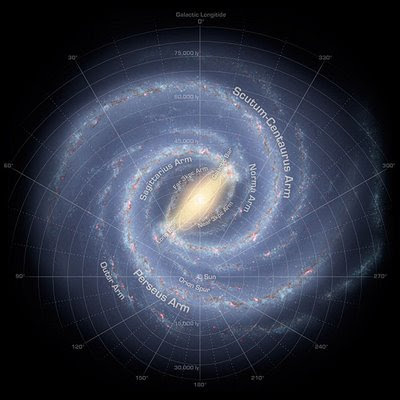
Milky Way- The Milky Way is the galaxy we live in. You can see the Milky Way in the sky with the naked eye if you are far enough away from the city and light pollution. What looks like a creamy band of light stretching across the sky is actually the combined light of millions of stars in our galaxy. The band of the Milky Way is the plane of our galaxy. We are looking at it from abut 2/3 of the way out in one of the galaxy's spiral arms. When you look towards the constellation Sagittarius, you are looking towards the center of our galaxy. As seem from above out galaxy probably looks about like this.

The Milky Way galaxy is approximately 100,000 light years in diameter and contains between 200 and 400 billion stars.
Only recently did we discover that our galaxy is actually a barred spiral galaxy, as shown above. All the gas and dust between us and the center and other side of the galaxy makes it difficult to study from within the galaxy at optical wavelengths. The Spitzer Space Telescope was able to study the central regions of our galaxy at infrared wavelengths in 2005 to give us a clearer picture of the true structure of our galaxy.

M13- Messier 13 is also known as the Great Globular Cluster in Hercules Hercules or NGC 6205. It was discovered by Edmond Halley in 1714 and entered into the catalog of Messier objects by Charles Messier in June of 1764. At magnitude 5.8, it is just visible to the unaided eye from a dark sky site.

Its diameter is about 145 light-years, and it is composed of several hundred thousand stars. M13 is 25,100 light-years away from Earth.


M57- The Ring Nebula is easily one of the most famous deep sky objects. Located east of the Hercules Cluster, M13, its usually the next stop on a typical star party tour. It is approximately 2300 light years away in the constellation of Lyra.

The 'Ring' is comprised of gas shed from the outer atmosphere of a highly evolved star in its last stages of life before becoming a white dwarf. In fact, with a large enough telescope, at the center of M57 you can see the this stellar remnant shining dimly at 15th magnitude.


M27- M27, the Dumbbell Nebula is another example of a planetary nebula like M57. This one is about 1200 light years away in the constellation Vulpecula.

Planetary nebulae are formed when medium or low mass stars, like our the Sun, exhaust the hydrogen fuel in their stellar core. Changes in the star's interior causes the outer layers of the star to expand and it becomes a red giant. The outer atmospheres of these red giants are expelled by hot stellar winds. This expanding gaseous shell forms a nebula, illuminated by ultraviolet light from the central star.

M20- Located in Sagittarius, this object is also known as the Trifid Nebula and NGC 6514. This one is a deep sky delight. The name means 'divided into three lobes'. M20 is actually a reflection nebula, emission nebula, dark nebula and star cluster all in one.

NOTE: Explain to your guests that you don't see all the glorious colors shown in these photographs when looking through the eyepiece of a telescope. In fact, some images are made clearer by adding false color to them, colors that are not even there visually.


M31- The Andromeda Galaxy. As the evening wears on Andromeda rises higher and higher in the east. I usually show people how to star hop with the unaided eye from the square of Pegasus, up to Beta Andromeda and then up to M31. Then once they have glimpsed it with the unaided eye, I tell them the light that they saw just now left Andromeda 2.5 million years ago, and just got here today to be seen by them. After such a long trip, it's a good thing it wasn't wasted!

By this time, many of your observing guests will actually be getting used to looking through the eyepiece and they will glean more detail than they were when they first began.

Viewed in small telescopes, M31 is usually disappointing to the uninitiated. They expect to see glorious spiral structure and color. It really just looks like an elongated cloud. In very large telescopes the oohs and aahs can be heard across the observing field. Its a good one to end the night with.

I know it's been a while...

Whew!

The end of August and the beginning of September have been incredibly busy for me. The result of work and personal overload has been the utter neglect of my blog. I feel pretty guilty about that, but it couldn't be avoided.

After successfully launching the AAVSO Writers Bureau, I've spent about a day per week administrating it and responding to requests for material and access to the bureau. I also spent the better part of three weeks writing a grant to fund the administration of the bureau. That was finally submitted last week, with a giant sigh of relief. I have two more grants on my to do list for the next couple weeks. Its a big part of my job as fundraiser for the AAVSO, and work always takes precedence over personal stuff like this blog.

I've spent way too many hours in the evenings trying to straighten out technical issues I was having with my cataclysmic variable website CVnet. I own and administrate the site, but haven't been able to access the editing features for two weeks. This is a serious problem, since the site needs to be updated in near real time as CV activity pops up. My partner and good friend in the UK, Gary Poyner, has been keeping the site updated recently, but he emailed me to say he was going on holiday for a week and I was gonna be on my own with CVnet for awhile. Well, long story short, my old Windows 98 PC just isn't up to the task any more, so now I have to use the newer PC in my wife's office to edit the site. I'm hoping that when I update my IBM laptop, which I just got back from repair, I'll be able to work from there to update the site.

I'm not really a techy type, or a tinkerer, but when telescope #2 went down I had to swallow hard and get inside the electronics to get her repaired. With much trepidation I disassembled all the electronic guts of my LX200 Classic and shipped them off to be overhauled. This is a much cheaper option than sending the whole telescope cross country. I should have the parts back mid-week and will be anxious to get her back online. Provided it passes the 'smoke test' upon reassembly!

An even larger time sink has been getting the house and observatories ready for the annual StarBeQue here on September 6. I spent the hottest weekend of the year, Labor Day weekend, painting the front porch and doing some major garden maintenance. Its gotten so I don't even like holiday weekends any more. We always seem to have some major project to complete and by Tuesday I can't wait to get back to work, so I can take it easy!

On top of all this craziness, the weather has been pretty good for observing, so I've been burning the candle at both ends many nights per week.

Well, the party is over. It was a great success, the food was excellent and the weather cooperated, so we were able to show everyone the moon, Jupiter and a host of deep sky objects before the clouds rolled in around 1AM.

I'm just about caught up with email and website updates, and the 'honey do list' that usually hangs on the fridge in various stages of completion is actually gone! I even managed to do the wiring in Irene's shop I've been promising to do for five years.

I have a dozen ideas for pieces for this blog in various stages of completion, so now that things have settled down a bit I should be able to post some content here before long.

Thanks for sticking with me. I'll try not to let it fall into inactivity for to long again.