It's 'official' now. The September issue of Sky and Telescope came in the mail yesterday, and the Editor in Chief has announced he is leaving the magazine "to try some new things and live a less hectic, less deadline driven life".
Even after contributing to 262 monthly issues of S&T, Rick still plans to add his byline or photo credit to the magazine or website occasionally.
Like everyone else I know, he isn't retiring, just changing jobs. He'll be acting as visiting scientist at Phillips Academy in Andover, MA. He'll be teaching some astronomy courses and serving as a mentor to students while turning their new science building and observatory into an active learning center. Sounds like a great gig for a 'retired' PhD!
Slacker Astronomy has an excellent podcast interview with Rick done at the June AAS meeting in St. Louis if you'd like to hear more from the man himself.
Good Luck, Rick; and thanks for all you've done to help astronomy enthusiasts over the years.


Carnival of Space #64!
Hi, everyone. The 64th installment of Carnival of Space is now online. This week it is hosted by the Music of the Spheres blog.
This weeks collection includes the Sun, black holes, Mars, colonizing Venus, astronomy software, telescopes and much, much more.
Check it out!
This weeks collection includes the Sun, black holes, Mars, colonizing Venus, astronomy software, telescopes and much, much more.
Check it out!
Polaris

I’ve won and lost a lot of money for people in silly bar bets about Polaris. People have the common misconception that Polaris, the North Star, is the brightest star in the sky. It’s not; Sirius holds that honor. It’s not even in the top 20 brightest stars. It comes in at number 48. That’ll be five dollars, thank you.
And as my friends and family all know, if you ask me an astronomy question after a few drinks, you are not going to get a short answer. So here is the rest of the fascinating story of the North Star, Polaris.
Polaris, also named alpha Ursa Minoris, is the brightest star in the Little Dipper. It marks the end of the handle. By a twist of luck, it also happens to reside very close to the North Celestial Pole (NCP). This is the point in the sky that all the stars in the north rotate around. It’s not exactly on the NCP, in fact it’s more than a Moons width away, so it scribes out a very small circle in long exposure star trail images like this one below. To the unaided eye it appears that all the stars rotate around Polaris while it remains fixed in one spot.

This fact has been known since ancient times, and Polaris has been used for navigation for centuries. The Chinese philosopher, Confucius, remarked, “He who exercises government by means of his virtue may be compared to the north polar star, which keeps its place and all the stars turn towards it.” Not only does it tell you where north is, its angle above the horizon roughly equals your latitude on Earth.
 Through binoculars Polaris looks like the diamond in a small asterism called the ‘Engagement Ring’.
Through a small telescope it is easy to see that Polaris is actually a double star, a fact discovered by William Herschel in 1780. This visual companion is known as alpha UMi B.
In 1929, another fainter and much closer companion was detected spectroscopically, but it wasn’t until 2006 that we were actually able to image this close dwarf star with the Hubble Space Telescope. This third member of the system is called alpha UMi Ab.
In spite of Shakespeare's Julius Caesar declaring, "I am as constant as the Northern Star, of whose true fixed and resting quality, there is no fellow in the firmament", not only is it not at rest in the firmament, the North Star is not constant in brightness either! Polaris is a variable star, and as it turns out, a rather interesting, unique variable star.
Polaris is a Cepheid variable. These are stars that pulsate with periods of a few days. The expansion and contraction of the outer atmosphere leads to changes in brightness. These stars are typically yellow giants or super-giants. They are huge stars, 40-180 times the radius of our Sun and much more massive. Polaris is six times as massive as our Sun and its radius is 45 times that of the Sun. Polaris is the closest of these stars, at a distance of 431 light years.
Cepheids have the unique characteristic that the period of the star, the time it takes to go from maximum light to minimum and back again, is directly proportional to the absolute magnitude (brightness) of the star. If we know the period and how bright the star ‘appears’ from earth, we can determine with a great deal of accuracy how far away the star is. In this way Cepheids have been used as benchmarks, or ‘standard candles’ to measure distances. Since these stars tend to be huge and bright, we can even see them in galaxies outside the Milky Way.
Since Cepheids are used to measure the distance to galaxies and the expansion rate of the universe, it is essential to understand their physics and evolution. Being able to image and study the exact motion of Polaris and alpha UMi Ab is a boon for astronomers who want to determine the mass of Polaris accurately. Analyzing the orbits of double stars is one of the most effective ways astronomers have for determining the mass of stars. Knowing the mass is the most important ingredient in understanding the evolution and other properties of stars.
Another interesting discovery in the last few years is that Polaris and many other Cepheids are shrouded in an envelope of gas, some 2 to 3 times the size of the stars themselves. The physical processes that have created these envelopes are still uncertain, but it is probable that these envelopes were created from matter ejected by the star itself.

As a consequence of the large amplitude oscillations of these humungous stars in a period of just a few days, material in the photospheres of these variable stars can be moving with velocities up to 100,000 km/h. It doesn't seem too unlikely that occasionally these stars might lose their gravitational grip on some of this fast moving material. Astronomers are studying the link between this pulsation, the mass loss and the formation of these envelopes.
Even stranger than all this, is the fact that Polaris has been steadily quieting down its pulsations over the last 100 years. Around 1900 the variations in brightness were about 10% of the average luminosity. During the last half of the 20th century Polaris’ variations had dropped to approximately 2%. No other Cepheid is known to have gone through this. Astronomers believed they were witnessing the evolution of the star before their very eyes, and that eventually we would see Polaris’ variations snuff out entirely.

In the course of performing this death-watch, it was discovered recently that Polaris is actually coming back to life! The amplitude of pulsations is on the rise. The evolutionary explanation of the changes in Polaris may not hold water any more, and astronomers will be scrambling to collect more data to figure out what is actually happening.
So, while she may not be the brightest star in the night sky, Polaris is one of the most intriguing.
"Hello, Operator. Mis-information, please."
I really try to be positive in my blog postings. As I have said before, there are enough cranky, crabby blogs out there, and this will not be one of them. But once in a while something is going to come up that ruffles my feathers and I'm going to be tempted to get cranky. Well, it's happened again. I'll try to use restraint.
This all revolves around the recent postings regarding the "supernova" V589 Puppis, that was "missed by legions of star watchers around the planet".
The only things remarkable about this story are 1) the fact that for the first time in history, a galactic nova was discovered by its x-ray emissions months after the initial outburst and 2) that this was so inaccurately reported 10 months after the fact by one of the more respectable astronomy sites in the universe today.
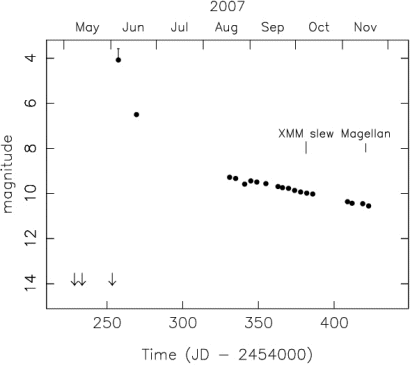
Here is the condensed version of the story with links to more information if you wish to investigate further. In October of 2007, the satellite XMM-Newton serendipitously discovered a transient x-ray source as it was slewing from one target to the next. This is known as the XMM-Newton Slew Survey. It's a clever way to maximize the use of the satellite. They're doing a survey of the sky even as they slew from one scheduled target to the next. This initial discovery was announced in an Astronomers Telegram in mid November. At this point all they knew was that it was very bright in x-rays, probably in our galaxy and might even be relatively close.
To follow up on this discovery a search for an optical counterpart was conducted. A normally 16th magnitude star in the vicinity of the x-ray event was identified as being brighter than normal. Spectra were taken of this star revealing emission lines typical of a galactic nova. Further investigation of the All Sky Automated Survey (ASAS) data for this star showed a couple lucky data points that the survey just barely managed to catch. The ASAS light curve, especially if it had a few more points in the declining part of the curve, would look very much like your typical nova. Case closed, the spectra indicate nova and the light curve says nova. It's a nova. NOT a supernova.
Unfortunately the sloppy reporting of this even reaches to the European Space Agency's XMM-Newton page where they write "Having been identified as a nova, the star was designated V598 Pup by the IAU." Actually, it is the General Catalog of Variable Stars (GCVS) that assigns names to novae, not the IAU. And thank God for that, seeing as how the IAU can't even figure out what to call Pluto and her friends. But that is another story for another cranky blog.
There's more! Many of the articles written about this discovery claim it must be some kind of miracle that this 4th magnitude, naked eye event wasn't noticed by the droves of amateur sky watchers and nova hunters looking up at the sky in June last year. I'm sorry, but any amateur astronomer who actually looks at the sky can tell you that in June and July Puppis is essentially in conjunction with the SUN! It's up during the day. You can't see it from Earth. The Sun is in the way! That's why I said the ASAS points were 'lucky'. That's also why they missed the rapid decline phase in July.
Only a professional astronomer who only observes with a space telescope would boldly claim “Anyone who went outside that night and looked towards the constellation of Puppis would have seen it.” C'mon, dude. The reason you didn't find it until months later is because you can't point your space telescope anywhere near the Sun or it will blow up. Not any more then I can see Puppis at night in June.
Now that would be a miracle.
This all revolves around the recent postings regarding the "supernova" V589 Puppis, that was "missed by legions of star watchers around the planet".
The only things remarkable about this story are 1) the fact that for the first time in history, a galactic nova was discovered by its x-ray emissions months after the initial outburst and 2) that this was so inaccurately reported 10 months after the fact by one of the more respectable astronomy sites in the universe today.
Here is the condensed version of the story with links to more information if you wish to investigate further. In October of 2007, the satellite XMM-Newton serendipitously discovered a transient x-ray source as it was slewing from one target to the next. This is known as the XMM-Newton Slew Survey. It's a clever way to maximize the use of the satellite. They're doing a survey of the sky even as they slew from one scheduled target to the next. This initial discovery was announced in an Astronomers Telegram in mid November. At this point all they knew was that it was very bright in x-rays, probably in our galaxy and might even be relatively close.
To follow up on this discovery a search for an optical counterpart was conducted. A normally 16th magnitude star in the vicinity of the x-ray event was identified as being brighter than normal. Spectra were taken of this star revealing emission lines typical of a galactic nova. Further investigation of the All Sky Automated Survey (ASAS) data for this star showed a couple lucky data points that the survey just barely managed to catch. The ASAS light curve, especially if it had a few more points in the declining part of the curve, would look very much like your typical nova. Case closed, the spectra indicate nova and the light curve says nova. It's a nova. NOT a supernova.
Unfortunately the sloppy reporting of this even reaches to the European Space Agency's XMM-Newton page where they write "Having been identified as a nova, the star was designated V598 Pup by the IAU." Actually, it is the General Catalog of Variable Stars (GCVS) that assigns names to novae, not the IAU. And thank God for that, seeing as how the IAU can't even figure out what to call Pluto and her friends. But that is another story for another cranky blog.
There's more! Many of the articles written about this discovery claim it must be some kind of miracle that this 4th magnitude, naked eye event wasn't noticed by the droves of amateur sky watchers and nova hunters looking up at the sky in June last year. I'm sorry, but any amateur astronomer who actually looks at the sky can tell you that in June and July Puppis is essentially in conjunction with the SUN! It's up during the day. You can't see it from Earth. The Sun is in the way! That's why I said the ASAS points were 'lucky'. That's also why they missed the rapid decline phase in July.
Only a professional astronomer who only observes with a space telescope would boldly claim “Anyone who went outside that night and looked towards the constellation of Puppis would have seen it.” C'mon, dude. The reason you didn't find it until months later is because you can't point your space telescope anywhere near the Sun or it will blow up. Not any more then I can see Puppis at night in June.
Now that would be a miracle.
Carnival of Space #63 is LIVE!
This week's Carnival of Space #63 is over at the Angry Astronomer site. Check it out. There are so many good articles this week you might want to make a pot of coffee first.
Common Thread
Here are three uncommon astronomers with a common thread that runs through their story. Even better, the plot has a twist.
John Goodricke was an English astronomer credited with the discovery of the variable stars beta Lyrae and delta Cephei. More notably, he was the first to explain the variability of Algol, the Demon Star, in Perseus. He proposed that it was a binary system and we were witnessing the eclipses of one of the components by the other, which resulted in the dimming of the starlight. Goodricke tragically died very young, at the age of twenty-two, 14 days after being named a Fellow of the Royal Society. It would be a hundred years before his theory of Algol's variability would be proved.
Annie Jump Cannon also discovered variable stars, over 300 of them in her career. She was one of 'Pickering's Women' who worked at Harvard College on the Henry Draper Catalog of 230,000 stars. She is most famous for helping develop the modern stellar classification system based on spectral type. Anyone who has studied stars knows the mnemonic 'Oh be a fine girl, kiss me' representing the spectral classifications O,B,A,F,G,K,M. Among the many honors and awards she earned in her illustrious 40 year career, she was the first woman elected an officer of the American Astronomical Society.
Henrietta Swan Leavitt worked tirelessly for years examining the photographic plates of the Harvard College Observatory. In the process of this work, she discovered and observed the variations in brightness of thousands of variable stars in images of the Magellanic Clouds. Many of these turned out to be Cepheid variables, named for Goodricke's delta Cephei, the prototype of this class of variable star. Leavitt discovered the relationship between the absolute magnitude and the period of these Cepheid variables. The brighter stars had longer periods and the fainter stars had shorter periods. This period-luminosity relationship formed the basis for one of the most important astronomical yardsticks for measuring the distance to stars, eventually proving that Andromeda and other galaxies were indeed island universes much farther away than previously imagined.
Yes, they were all impressive, intelligent people. Yes, they were all astronomers. Yes, they all were involved in variable star research and discovery. But what you probably didn't know is they achieved all this in spite of being deaf.
John Goodricke was an English astronomer credited with the discovery of the variable stars beta Lyrae and delta Cephei. More notably, he was the first to explain the variability of Algol, the Demon Star, in Perseus. He proposed that it was a binary system and we were witnessing the eclipses of one of the components by the other, which resulted in the dimming of the starlight. Goodricke tragically died very young, at the age of twenty-two, 14 days after being named a Fellow of the Royal Society. It would be a hundred years before his theory of Algol's variability would be proved.
Annie Jump Cannon also discovered variable stars, over 300 of them in her career. She was one of 'Pickering's Women' who worked at Harvard College on the Henry Draper Catalog of 230,000 stars. She is most famous for helping develop the modern stellar classification system based on spectral type. Anyone who has studied stars knows the mnemonic 'Oh be a fine girl, kiss me' representing the spectral classifications O,B,A,F,G,K,M. Among the many honors and awards she earned in her illustrious 40 year career, she was the first woman elected an officer of the American Astronomical Society.
Henrietta Swan Leavitt worked tirelessly for years examining the photographic plates of the Harvard College Observatory. In the process of this work, she discovered and observed the variations in brightness of thousands of variable stars in images of the Magellanic Clouds. Many of these turned out to be Cepheid variables, named for Goodricke's delta Cephei, the prototype of this class of variable star. Leavitt discovered the relationship between the absolute magnitude and the period of these Cepheid variables. The brighter stars had longer periods and the fainter stars had shorter periods. This period-luminosity relationship formed the basis for one of the most important astronomical yardsticks for measuring the distance to stars, eventually proving that Andromeda and other galaxies were indeed island universes much farther away than previously imagined.
Yes, they were all impressive, intelligent people. Yes, they were all astronomers. Yes, they all were involved in variable star research and discovery. But what you probably didn't know is they achieved all this in spite of being deaf.
Astronomical Acronyms
Acronyms, acronyms...doesn't anybody know how to spell any more? Every article or blog I read, every conference I attend, even watching the cable news channels, I am constantly bombarded with acronyms for everything. I rattle them off in conversation all the time without thinking, and yet I'm sure there are people listening, nodding their heads knowingly, who haven't got a clue what the heck I am talking about.
I do the same thing. My boss, a PhD astronomer, throws these things around as if they were real words and I should know what they are. I nod my head knowingly and scrape by as best I can until I have time to research them later. I usually spend about an hour or so investigating each set of mystery letters, divining the meaning of it all, so next time it comes up I can make an intelligent comment, or at least not stand there with a dumb look on my face.
This blog was inspired by recent discussions about all sky surveys, which naturally all have acronyms for names. My guess is that this will turn into a series of blogs on acronyms related to various aspects of astronomy. If you have a suggestion, leave it in the comments section, please.
Without further ado, here are Simointerpretations of popular acronyms related to astronomical surveys.
 2MASS The Two Micron All Sky Survey is an all sky survey in the near infrared performed by twin 1.3 meter telescopes, one at Whipple Observatory in Arizona and the other at Cerro Tololo Inter-American Observatory in Chile. The University of Massachusetts lead this project. They were responsible for developing the cameras, telescopes and on-site computing systems. The project was funded by NASA and the National Science Foundation. It ran from 1997 to completion in 2001. The resulting 2MASS All Sky Catalog was released in 2003.
The reason it isn't called TMASS is because there was already an all sky survey in the infrared named TMASS done in the 1960's. 2MASS canvassed the sky with about 50,000 times the sensitivity of TMASS. They were able to study galaxies and objects typically hidden from view in optical wavelengths by dust in our galaxy and survey the sky for brown dwarfs and other oddball objects that emit most of their feeble light in the infrared.
To summarize, 2MASS, run by U Mass, funded by NASA and NSF, replaced TMASS by surveying the sky with twin 1.3M telescopes in the near-IR from Mt. Hopkins and CTIO.
Sorry, I couldn't resist.
ASAS The All Sky Automated Survey is an ongoing effort. Four small telescopes in Chile survey the southern sky, from +28 degrees to the south pole, down to about 14th magnitude every clear night in V and I bands. ASAS North, covering the northern sky, should be online soon.
 HAT The HAT acronym stands for Hungarian-made Automated Telescope , because it was developed by a small group of Hungarians who met through the Hungarian Astronomical Association (HAA) back in 1999. The scientific goal of the project is to detect and characterize extrasolar planets and bright variable stars. The HAT and ASAS telescopes are very similar in size and appearance, since both are the brainchild of Bohdan Paczynski. The telescope pictured here is the HAT model.
LINEAR Lincoln Near Earth Asteroid Research is a Massachusetts Institute of Technology (MIT) Lincoln Laboratory program devoted to detecting and cataloging Near Earth Objects (NEOs) that threaten Earth. As of the end of 2007, LINEAR had discovered 225,957 asteroids. The twin telescopes located at the White Sands Missile Range in New Mexico also manage to serendipitously discover their fair share of comets, 236 at the end of 2007, which has discouraged many amateur comet hunters. These comets all get the unfortunate, unromantic name of comet LINEAR.
 LSST The Large Synoptic Survey Telescope isn't even online yet, but I hear news about it and its development every week. This survey will utilize an 8.4 meter telescope with a 10 square degree field of view to survey the entire night sky visible from Chile once every three nights. The LSST camera will be 1.6 by 3 meters and weigh 2800 kilograms! It will just sit there night after night, cooled to -100C, endlessly shooting 15 second exposures, tracking objects that change or move on rapid timescales, like supernovae, near-Earth asteroids, and as yet to be discovered Kuiper Belt Objects. It will also be used to study faint, distant galaxies and dark matter.
NEAT Near Earth Asteroid Tracking, another program designed to detect and track NEOs, both asteroids and comets. This survey uses two 48" telescopes, one in Hawaii and one on California.
NSVS The Northern Sky Variability Survey is approximately one years worth of data from the ROTSE experiment (yet ANOTHER survey acronym!) used to detect and classify variable stars in the northern sky.
OGLE The Optical Gravitational Lensing Experiment project's main science goal was to search for dark matter using microlensing phenomena. The cameras basically stare at the Large and Small Magellanic Clouds and the galactic bulge, because that's where the most background stars appear from Earth. This experiment has to be considered a smashing success as they have not only detected microlensing phenomena, but discovered thousands of variable stars, dozens of exoplanetary transits, performed precision astrometry and photometry on thousands of stars, and mapped interstellar extinction from dust in our galaxy. By the way, this experiment was also proposed by Bohdan Paczynski. I guess you'd have to call him the father of astronomical surveys, eh?
PanStarrs Sounds like a Howard Hughes space enterprise, doesn't it? This project needs an acronym, because it has way too long a name- Panoramic Survey Telescope & Rapid Response System.
I just love this picture of Hubble at the finder scope of the 48", conveniently pointed for him to pose at the eyepiece as if he actually guided long exposures with a pipe in his mouth.
 SDSS The Sloan Digital Sky Survey is the "most ambitious astronomical survey ever undertaken. When completed, it will provide detailed optical images covering more than a quarter of the sky, and a 3-dimensional map of about a million galaxies and quasars. As the survey progresses, the data are released to the scientific community and the general public in annual increments."
This 2.5 meter telescope system is straight out of science fiction. The dual spectrographs are fed by fiber optic cables inserted through pre-drilled precision plates in order to measure up to 600 galaxies or stars per exposure. The list of discoveries and science accomplished thus far with SDSS is impressive.
And last but not least...
UCAC Two acronyms embedded in an acronym! USNO CCD Astrograph Catalog. USNO is the US Naval Observatory and CCD is Charged Coupled Device. Egads, layers upon layers of acronyms within acronyms. This is an all sky astrometric (positional) survey measuring the position and proper motion of stars to a very high degree of accuracy. The final catalog should be released in 2008.
If you haven't had enough yet, here is a link to a more extensive, although not necessarily current, listing of astronomical surveys, most with acronyms for names.
There now, don't you feel smart?
The next time someone mentions one of these surveys you'll know what they are talking about. Then you can look around to see who is nodding their head knowingly with that blank expression on their face, and have pity.
I do the same thing. My boss, a PhD astronomer, throws these things around as if they were real words and I should know what they are. I nod my head knowingly and scrape by as best I can until I have time to research them later. I usually spend about an hour or so investigating each set of mystery letters, divining the meaning of it all, so next time it comes up I can make an intelligent comment, or at least not stand there with a dumb look on my face.
This blog was inspired by recent discussions about all sky surveys, which naturally all have acronyms for names. My guess is that this will turn into a series of blogs on acronyms related to various aspects of astronomy. If you have a suggestion, leave it in the comments section, please.
Without further ado, here are Simointerpretations of popular acronyms related to astronomical surveys.
 2MASS The Two Micron All Sky Survey is an all sky survey in the near infrared performed by twin 1.3 meter telescopes, one at Whipple Observatory in Arizona and the other at Cerro Tololo Inter-American Observatory in Chile. The University of Massachusetts lead this project. They were responsible for developing the cameras, telescopes and on-site computing systems. The project was funded by NASA and the National Science Foundation. It ran from 1997 to completion in 2001. The resulting 2MASS All Sky Catalog was released in 2003.
The reason it isn't called TMASS is because there was already an all sky survey in the infrared named TMASS done in the 1960's. 2MASS canvassed the sky with about 50,000 times the sensitivity of TMASS. They were able to study galaxies and objects typically hidden from view in optical wavelengths by dust in our galaxy and survey the sky for brown dwarfs and other oddball objects that emit most of their feeble light in the infrared.
To summarize, 2MASS, run by U Mass, funded by NASA and NSF, replaced TMASS by surveying the sky with twin 1.3M telescopes in the near-IR from Mt. Hopkins and CTIO.
Sorry, I couldn't resist.
ASAS The All Sky Automated Survey is an ongoing effort. Four small telescopes in Chile survey the southern sky, from +28 degrees to the south pole, down to about 14th magnitude every clear night in V and I bands. ASAS North, covering the northern sky, should be online soon.
 HAT The HAT acronym stands for Hungarian-made Automated Telescope , because it was developed by a small group of Hungarians who met through the Hungarian Astronomical Association (HAA) back in 1999. The scientific goal of the project is to detect and characterize extrasolar planets and bright variable stars. The HAT and ASAS telescopes are very similar in size and appearance, since both are the brainchild of Bohdan Paczynski. The telescope pictured here is the HAT model.
LINEAR Lincoln Near Earth Asteroid Research is a Massachusetts Institute of Technology (MIT) Lincoln Laboratory program devoted to detecting and cataloging Near Earth Objects (NEOs) that threaten Earth. As of the end of 2007, LINEAR had discovered 225,957 asteroids. The twin telescopes located at the White Sands Missile Range in New Mexico also manage to serendipitously discover their fair share of comets, 236 at the end of 2007, which has discouraged many amateur comet hunters. These comets all get the unfortunate, unromantic name of comet LINEAR.
 LSST The Large Synoptic Survey Telescope isn't even online yet, but I hear news about it and its development every week. This survey will utilize an 8.4 meter telescope with a 10 square degree field of view to survey the entire night sky visible from Chile once every three nights. The LSST camera will be 1.6 by 3 meters and weigh 2800 kilograms! It will just sit there night after night, cooled to -100C, endlessly shooting 15 second exposures, tracking objects that change or move on rapid timescales, like supernovae, near-Earth asteroids, and as yet to be discovered Kuiper Belt Objects. It will also be used to study faint, distant galaxies and dark matter.
NEAT Near Earth Asteroid Tracking, another program designed to detect and track NEOs, both asteroids and comets. This survey uses two 48" telescopes, one in Hawaii and one on California.
NSVS The Northern Sky Variability Survey is approximately one years worth of data from the ROTSE experiment (yet ANOTHER survey acronym!) used to detect and classify variable stars in the northern sky.
OGLE The Optical Gravitational Lensing Experiment project's main science goal was to search for dark matter using microlensing phenomena.
 The cameras basically stare at the Large and Small Magellanic Clouds and the galactic bulge, because that's where the most background stars appear from Earth. This experiment has to be considered a smashing success as they have not only detected microlensing phenomena, but discovered thousands of variable stars, dozens of exoplanetary transits, performed precision astrometry and photometry on thousands of stars, and mapped interstellar extinction from dust in our galaxy. By the way, this experiment was also proposed by Bohdan Paczynski. I guess you'd have to call him the father of astronomical surveys, eh?
PanStarrs Sounds like a Howard Hughes space enterprise, doesn't it? This project needs an acronym, because it has way too long a name- Panoramic Survey Telescope & Rapid Response System.
 The immediate science goal of Pan-STARRS is to discover and characterize Earth-approaching objects, both asteroids and comets, that might pose a danger to our planet. Sound familiar? Musta' been a whole pot of money available for these type surveys once they became politically correct. "Hey, I see an asteroid. Send me money!"
The huge volume of images produced by this system will also provide valuable data for many other kinds of scientific programs. I hear it referenced in regards to all the transient and variable star data it will produce on a regular basis. The challenge for variable star researchers will be to scan through all the data and find those few interesting objects worthy of follow up observation programs. This scope and LSST are supposed to provide nightly alerts of transient phenomena, as well as terabytes of data. We need to get more AAVSO observers ready, and we need them now!

I just love this picture of Hubble at the finder scope of the 48", conveniently pointed for him to pose at the eyepiece as if he actually guided long exposures with a pipe in his mouth.
 SDSS The Sloan Digital Sky Survey is the "most ambitious astronomical survey ever undertaken. When completed, it will provide detailed optical images covering more than a quarter of the sky, and a 3-dimensional map of about a million galaxies and quasars. As the survey progresses, the data are released to the scientific community and the general public in annual increments."
This 2.5 meter telescope system is straight out of science fiction. The dual spectrographs are fed by fiber optic cables inserted through pre-drilled precision plates in order to measure up to 600 galaxies or stars per exposure. The list of discoveries and science accomplished thus far with SDSS is impressive.
And last but not least...
UCAC Two acronyms embedded in an acronym! USNO CCD Astrograph Catalog. USNO is the US Naval Observatory and CCD is Charged Coupled Device. Egads, layers upon layers of acronyms within acronyms. This is an all sky astrometric (positional) survey measuring the position and proper motion of stars to a very high degree of accuracy. The final catalog should be released in 2008.
If you haven't had enough yet, here is a link to a more extensive, although not necessarily current, listing of astronomical surveys, most with acronyms for names.
There now, don't you feel smart?
The next time someone mentions one of these surveys you'll know what they are talking about. Then you can look around to see who is nodding their head knowingly with that blank expression on their face, and have pity.
Carnival of Space #62
Carnival of Space is back with its 62nd installment. Dave Mosher, Discovery Space's site producer has put together a unique slide show extravaganza allowing readers to flip through the Carnival images and link out to their respective blogs.
Kudos to Dave and his new Discovery blog site Space Disco.
Kudos to Dave and his new Discovery blog site Space Disco.
The Manners of Skeptisism
I've read and heard far too many political, religious and skeptical rants on what I thought were supposed to be science blogs, podcasts and television shows lately, and it's got me stirred up. So I'm writing one of my own just to get it off my chest.
I admit to being an atheist, and I don't think much of UFO claims, ghost sightings or psychic powers, but I don't close the door entirely on any of this stuff. I'm skeptical, and in the end, all I want is someone to show me proof. Then you can win the argument.
It would be comforting to know that God is somehow responsible for all this mess and beauty at the same time. It would be exciting to finally know for sure we are not alone in the Universe. It would be fun to come back and haunt some of the people I've known in my life after I'm gone, or check in on the great-great-great grandkids one day from the beyond.
Mostly, I avoid getting in these discussions because I've found that the people who rabidly defend their point of view are never interested in hearing your point of view. It is always a one way conversation. No one listens to the other person. It's futile and a waste of time. You are not going to change their mind suddenly with your brilliant argument today.
That is why I wonder at the attitude of so many of the 'skeptics' who write blogs, author books, do podcasts and appear on TV. I've grown as disinterested in reading or hearing their rants as I am of hearing the rants of the fanatics and religious zealots they are so eager to discredit. To me, they come off as arrogant, sarcastic, egotistical, inflexible, bitter, and just plain rude. I don't care how many books you've written, or how many degrees you have, you don't know EVERYTHING. Many of these skeptics act like they DO know everything. Apparently there is a God, and THEY are He.
Infinitely worse, and far more annoying, is the way they talk about anyone who doesn't agree with them. In the "world according to skeptics" if you don't think like they do, believe in what they do, or disagree with them, you are obviously undereducated, narrow-minded, ignorant, j-holes not worthy of breathing the same air as the almighty brilliant ones. The skeptics I'm referring to often condescend to the people who disagree with a wink and a nod to their readers or audience, as if to say, "Just look at these stupid losers. We know how pathetic they are."
The other night I watched Phil Nye, the science guy, on Larry King arguing with a panel of people who had different opinions about what was really going on with the Roswell incident. Some of them were merely recounting what their parents had told them when they were children, or telling of veiled confessions made by people who were scared to death of the long hand of the government. Most of them calmly and succinctly stated their case, or told their story, including a former NASA astronaut. None of them was losing their cool or jumping up and down all excited. They weren't looking for converts or trying to win the argument once and for all.
But the science guy was rolling his eyes and acting like a superior intellect the entire time, dismissing everything and anything these people had to say, often without hearing all of what they had to say because he was too busy being rude and interrupting them. None of his counter arguments were particularly compelling, and yet he acted as if only a fool would disagree with him. What a jerk.
I don't know why so many of these 'skeptics' have this attitude problem, and I don't care. Maybe they grew up in a sheltered environment where they didn't have to live with, respect and cooperate with other people. That's sad. It seems to me they're not as interested in making the world a better place as they are in showing everyone how smart they are. What a waste of potential good.
All I know is I don't want to hear any more from these social retards. I won't be plugging, feeding, linking, reading or watching anyone who can't promote science and rational thinking without making the other guy look bad.
Get some manners or get lost.
I admit to being an atheist, and I don't think much of UFO claims, ghost sightings or psychic powers, but I don't close the door entirely on any of this stuff. I'm skeptical, and in the end, all I want is someone to show me proof. Then you can win the argument.
It would be comforting to know that God is somehow responsible for all this mess and beauty at the same time. It would be exciting to finally know for sure we are not alone in the Universe. It would be fun to come back and haunt some of the people I've known in my life after I'm gone, or check in on the great-great-great grandkids one day from the beyond.
Mostly, I avoid getting in these discussions because I've found that the people who rabidly defend their point of view are never interested in hearing your point of view. It is always a one way conversation. No one listens to the other person. It's futile and a waste of time. You are not going to change their mind suddenly with your brilliant argument today.
That is why I wonder at the attitude of so many of the 'skeptics' who write blogs, author books, do podcasts and appear on TV. I've grown as disinterested in reading or hearing their rants as I am of hearing the rants of the fanatics and religious zealots they are so eager to discredit. To me, they come off as arrogant, sarcastic, egotistical, inflexible, bitter, and just plain rude. I don't care how many books you've written, or how many degrees you have, you don't know EVERYTHING. Many of these skeptics act like they DO know everything. Apparently there is a God, and THEY are He.
Infinitely worse, and far more annoying, is the way they talk about anyone who doesn't agree with them. In the "world according to skeptics" if you don't think like they do, believe in what they do, or disagree with them, you are obviously undereducated, narrow-minded, ignorant, j-holes not worthy of breathing the same air as the almighty brilliant ones. The skeptics I'm referring to often condescend to the people who disagree with a wink and a nod to their readers or audience, as if to say, "Just look at these stupid losers. We know how pathetic they are."
The other night I watched Phil Nye, the science guy, on Larry King arguing with a panel of people who had different opinions about what was really going on with the Roswell incident. Some of them were merely recounting what their parents had told them when they were children, or telling of veiled confessions made by people who were scared to death of the long hand of the government. Most of them calmly and succinctly stated their case, or told their story, including a former NASA astronaut. None of them was losing their cool or jumping up and down all excited. They weren't looking for converts or trying to win the argument once and for all.
But the science guy was rolling his eyes and acting like a superior intellect the entire time, dismissing everything and anything these people had to say, often without hearing all of what they had to say because he was too busy being rude and interrupting them. None of his counter arguments were particularly compelling, and yet he acted as if only a fool would disagree with him. What a jerk.
I don't know why so many of these 'skeptics' have this attitude problem, and I don't care. Maybe they grew up in a sheltered environment where they didn't have to live with, respect and cooperate with other people. That's sad. It seems to me they're not as interested in making the world a better place as they are in showing everyone how smart they are. What a waste of potential good.
All I know is I don't want to hear any more from these social retards. I won't be plugging, feeding, linking, reading or watching anyone who can't promote science and rational thinking without making the other guy look bad.
Get some manners or get lost.
Maria Mitchell
In October this year, the AAVSO will be holding its annual fall meeting on Nantucket, in conjunction with the Maria Mitchell Observatory, who are celebrating their 100th anniversary. I had vague notions about who Maria (pronounced Ma-RHY-uh) Mitchell was, but as I began making travel arrangements for the meeting and doing a bit of research about the island, its history and the observatory, a fascinating story unfolded I think you might enjoy.
Maria was born on Nantucket, August 1, 1818. She was the third of ten children born to William and Lydia Mitchell. Many of her cousins, aunts and uncles proved to be quite brilliant, self-taught people. Among them, Benjamin Franklin, related on her father's side of the family.

Her parents were Quakers, and as such, valued education and believed in intellectual equality of the sexes. Because many Nantucket women were responsible for taking care of the children, homes and family business while the men were away at sea for months, sometimes years, they developed into strong, independent women. Maria's father was an active amateur astronomer, who gave lectures to learned societies and showed people the Moon and other celestial objects through his back yard telescope as Maria was growing up. These facts all conspired to allow Maria to become America's first woman astronomer.
Let me remind you that for most of Maria's life, slavery in America was a fact of life and the women of Nantucket were not allowed to vote or own property. The inequality between the rights, pay and working conditions of women and men is a recurring theme in Maria Mitchell's life.
Maria's extensive home schooling, formal education and self-teaching landed her her first job at the age of sixteen as a mathematics teacher. At the age of eighteen she was offered the job as librarian for the Nantucket Atheneum. The Atheneum was not only a library which housed over 3,200 books, but it had a lecture hall, a museum room and served as a local cultural center.
Working in the Atheneum allowed her access to all the books she could devour. These included books on astronomy and celestial mechanics. Since many advanced astronomy publications and journals were written in Latin or German, she taught herself these languages so she could read more. In the end, she was able to give herself a college education, something she could not have achieved elsewhere, since women were not admitted to the best colleges in the early 1800's.
Through her father and working at the Atheneum, Maria became known to many of the prominent amateur scientists and astronomers of the day, including expert clock maker and astronomer William Bond, who became the first Harvard astronomer. On visiting the Harvard observatory in 1847 she was privileged to be one of the first people in America to observe the newly discovered planet Neptune with Bond through the observatory's fifteen inch refractor.
The event that catapulted Maria into worldwide fame was her discovery of a comet in the autumn of 1847. The only other woman to have discovered a comet before this was Caroline Herschel. "Miss Mitchell's Comet" (C/1847 T1) earned her the gold medal awarded by King Frederick VI of Denmark for the discovery of telescopic comets (those not visible to the unaided eye). This award was not without some controversy, as another astronomer, Francesco de Vico, had independently discovered the comet a couple days later, but had been able to report his finding sooner than Maria. Everything was sorted out in the end and Maria was given full credit for the discovery and the gold medal award.
Her career bloomed quickly after that. In 1848 she was elected the first woman member of the American Academy of Arts and Sciences, and to the American Society for the Advancement of Science in 1850. In 1849 she was offered a position with the U.S. Nautical Almanac Office as a 'computer' (one who does computations) of tables of positions of the planet Venus.
In 1865 she became professor of astronomy and director of the college observatory at the newly-opened Vassar College in Poughkeepsie, New York. Mitchell and her father moved into the Vassar Observatory, the first building of the college to be completed, where she had the use of a twelve-inch telescope, the third largest in the United States at that time.
Her students did original research and studied the heavens from the dome at the top of the observatory. They were frequently aroused from their sleep in their bedrooms in Main Building and made their way over to the observatory in the dark to ascend to the dome, or the roof of the building, to study Jupiter or Saturn. Mitchell continued her own research in studying the surface features of Jupiter and Saturn and photographing stars and the Sun.
In 1869 she was the first woman elected to the American Philosophical Society. In 1873, she co-founded the American Association for the Advancement of Women and served as its president from 1874 to 1876. In 1873 she attended the first meeting of the Women's Congress. That Congress was also attended by many famous women's rights activists, including Elizabeth Cady Stanton, and Susan B. Anthony. In fact, after serving as observatory director and professor at Vassar for several years she found out that she was being paid far less than some male professors with far less experience and stature. She demanded a salary increase and got it!
She was also involved in the anti-slavery movement. She refused to wear clothes made of cotton as a protest against slavery in the South. She kept up this personal boycott even after the Civil War had ended and the slaves were freed.
Maria Mitchell retired from Vassar in 1888 because of failing health. She died June 28, 1889 of a brain disease, of all things. Friends and supporters founded the Maria Mitchell Association on Nantucket in 1902. The observatory they built on Nantucket was named in her honor.
In 1905 she was elected to the Hall of Fame of Great Americans at New York University (now at Bronx Community College). In 1994, she was elected to the National Women's Hall of Fame in Seneca Falls, New York.
During World War II one of the Liberty Ships was named for her, the SS Maria Mitchell, and Mitchell Crater on the Moon is named in her honor. Asteroid 1455 Mitchella is also named for her. What an incredible woman. She's got the astronomical trifecta; a comet, a crater and an asteroid named in her honor!
Anyway, I know my trip to Nantucket will be a little more enjoyable now that I know more about her most famous daughter. I hope you found this story as interesting and inspiring as I did.
Maria was born on Nantucket, August 1, 1818. She was the third of ten children born to William and Lydia Mitchell. Many of her cousins, aunts and uncles proved to be quite brilliant, self-taught people. Among them, Benjamin Franklin, related on her father's side of the family.

Her parents were Quakers, and as such, valued education and believed in intellectual equality of the sexes. Because many Nantucket women were responsible for taking care of the children, homes and family business while the men were away at sea for months, sometimes years, they developed into strong, independent women. Maria's father was an active amateur astronomer, who gave lectures to learned societies and showed people the Moon and other celestial objects through his back yard telescope as Maria was growing up. These facts all conspired to allow Maria to become America's first woman astronomer.
Let me remind you that for most of Maria's life, slavery in America was a fact of life and the women of Nantucket were not allowed to vote or own property. The inequality between the rights, pay and working conditions of women and men is a recurring theme in Maria Mitchell's life.
Maria's extensive home schooling, formal education and self-teaching landed her her first job at the age of sixteen as a mathematics teacher. At the age of eighteen she was offered the job as librarian for the Nantucket Atheneum. The Atheneum was not only a library which housed over 3,200 books, but it had a lecture hall, a museum room and served as a local cultural center.
Working in the Atheneum allowed her access to all the books she could devour. These included books on astronomy and celestial mechanics. Since many advanced astronomy publications and journals were written in Latin or German, she taught herself these languages so she could read more. In the end, she was able to give herself a college education, something she could not have achieved elsewhere, since women were not admitted to the best colleges in the early 1800's.
Through her father and working at the Atheneum, Maria became known to many of the prominent amateur scientists and astronomers of the day, including expert clock maker and astronomer William Bond, who became the first Harvard astronomer. On visiting the Harvard observatory in 1847 she was privileged to be one of the first people in America to observe the newly discovered planet Neptune with Bond through the observatory's fifteen inch refractor.
The event that catapulted Maria into worldwide fame was her discovery of a comet in the autumn of 1847. The only other woman to have discovered a comet before this was Caroline Herschel. "Miss Mitchell's Comet" (C/1847 T1) earned her the gold medal awarded by King Frederick VI of Denmark for the discovery of telescopic comets (those not visible to the unaided eye). This award was not without some controversy, as another astronomer, Francesco de Vico, had independently discovered the comet a couple days later, but had been able to report his finding sooner than Maria. Everything was sorted out in the end and Maria was given full credit for the discovery and the gold medal award.
Her career bloomed quickly after that. In 1848 she was elected the first woman member of the American Academy of Arts and Sciences, and to the American Society for the Advancement of Science in 1850. In 1849 she was offered a position with the U.S. Nautical Almanac Office as a 'computer' (one who does computations) of tables of positions of the planet Venus.
In 1865 she became professor of astronomy and director of the college observatory at the newly-opened Vassar College in Poughkeepsie, New York. Mitchell and her father moved into the Vassar Observatory, the first building of the college to be completed, where she had the use of a twelve-inch telescope, the third largest in the United States at that time.
Her students did original research and studied the heavens from the dome at the top of the observatory. They were frequently aroused from their sleep in their bedrooms in Main Building and made their way over to the observatory in the dark to ascend to the dome, or the roof of the building, to study Jupiter or Saturn. Mitchell continued her own research in studying the surface features of Jupiter and Saturn and photographing stars and the Sun.

In 1869 she was the first woman elected to the American Philosophical Society. In 1873, she co-founded the American Association for the Advancement of Women and served as its president from 1874 to 1876. In 1873 she attended the first meeting of the Women's Congress. That Congress was also attended by many famous women's rights activists, including Elizabeth Cady Stanton, and Susan B. Anthony. In fact, after serving as observatory director and professor at Vassar for several years she found out that she was being paid far less than some male professors with far less experience and stature. She demanded a salary increase and got it!
She was also involved in the anti-slavery movement. She refused to wear clothes made of cotton as a protest against slavery in the South. She kept up this personal boycott even after the Civil War had ended and the slaves were freed.
Maria Mitchell retired from Vassar in 1888 because of failing health. She died June 28, 1889 of a brain disease, of all things. Friends and supporters founded the Maria Mitchell Association on Nantucket in 1902. The observatory they built on Nantucket was named in her honor.
In 1905 she was elected to the Hall of Fame of Great Americans at New York University (now at Bronx Community College). In 1994, she was elected to the National Women's Hall of Fame in Seneca Falls, New York.

During World War II one of the Liberty Ships was named for her, the SS Maria Mitchell, and Mitchell Crater on the Moon is named in her honor. Asteroid 1455 Mitchella is also named for her. What an incredible woman. She's got the astronomical trifecta; a comet, a crater and an asteroid named in her honor!
Anyway, I know my trip to Nantucket will be a little more enjoyable now that I know more about her most famous daughter. I hope you found this story as interesting and inspiring as I did.
Carnival of Space #61
If you know about 'Carnival of Space' you can stop reading now and just go here to read it this week.
'Carnival' is a weekly collection of samples from space, science and astronomy blogs all brought together under one roof on one host site each week. This week's collection is really quite good. There are deep, serious scientific discussions, some very good humor and even a bit of philosophical musing.
The rest you can find out for yourself by visiting Mang's Bat Page for this week's Carnival of Space #61.
'Carnival' is a weekly collection of samples from space, science and astronomy blogs all brought together under one roof on one host site each week. This week's collection is really quite good. There are deep, serious scientific discussions, some very good humor and even a bit of philosophical musing.
The rest you can find out for yourself by visiting Mang's Bat Page for this week's Carnival of Space #61.
Dusty TOADs
In cataclysmic variable star circles, TOAD is the term used for a special class of dwarf novae, Tremendous Outburst Amplitude Dwarf novae.
Dwarf novae, are in fact binary systems made of a white dwarf primary and a less evolved (normal) star orbiting around each other in such close proximity that the white dwarf's gravitational attraction is actually stripping away the outer layers of its companion's atmosphere.
This cannibalized material cannot fall directly down to the surface of the white dwarf, but instead goes into orbit around it, creating a disk called an accretion disk. This disk material is so hot and releases so much energy and light, that it can be thought of almost as if it were a flat star!
Now and then, something happens, we aren't quite sure what, that tips the balancing act and this material suddenly falls down to the surface of the white dwarf and ignites an outburst that makes the system hundreds of times brighter than it is in quiescence.
Normal, garden variety dwarf novae undergo outbursts irregularly in time scales of weeks to months to a couple years in between outbursts. Other systems may take several years or decades in between eruptions. Generally speaking, the longer it takes between outbursts, the bigger the bang.
TOADs belong to this class of rarely outbursting stars that have brighter than normal outbursts. Because they don't happen very often, and we never know when the next one will occur, astronomers are interested in studying these objects and their unusual nature.
The light from the accretion disk and the light from the white dwarf make it very difficult to study or 'see' the secondary star. Only before or after an outburst, when the system is relatively quiet, do astronomers have a chance at studying the light from the secondary.
And what better cataclysmic variable target to try and catch this portion of the spectrum in than a system that rarely goes into outburst? So, when given the opportunity to get 'discretionary time' on the Spitzer Space Telescope, which studies the universe in the infrared portion of the electromagnetic spectrum, Steve Howell suggested they point it at one of these TOADs, WZ Sagittae, to see what they could see about the secondary of the system.
Once the data were analyzed, Steve and his team were astonished to find they couldn't see the secondary at all! What they found instead was a large, asymmetric disk of dusty material surrounding the accretion disk. Because this disk contains so little mass, it is completely invisible in optical and near-IR wavelengths. In a way, it is 'dark matter'. The pre-print paper can be read at arXiv:0805.4818v1 [astro-ph].
This discovery has implications for accretion disks in general, other interacting binaries, even the accreting black holes in active galaxies. It also raises a lot of interesting questions. Where is this dust coming from? What exactly is it made of? Do all dwarf novae have dusty rings around them?
To follow up on this discovery, Steve and his team have acquired another set of target of opportunity observations with Spitzer. AAVSO observers around the world are monitoring a list of TOADs. Once an outburst of one of the stars on the list is detected, observations with the space telescope will commence a couple weeks after the outburst, and then again several times as the system falls back to quiescence, to see if dust formation can be detected and what, if any, changes take place over time.
Check here in the future for results from this interesting pro-am collaboration.
Dwarf Novae depiction "Cataclysm III" copyright Mark A. Garlick and used with permission. Please do not use this image in any way whatsoever without first contacting the artist.
Spitzer Space Telescope image copyright NASA.
Dwarf novae, are in fact binary systems made of a white dwarf primary and a less evolved (normal) star orbiting around each other in such close proximity that the white dwarf's gravitational attraction is actually stripping away the outer layers of its companion's atmosphere.
This cannibalized material cannot fall directly down to the surface of the white dwarf, but instead goes into orbit around it, creating a disk called an accretion disk. This disk material is so hot and releases so much energy and light, that it can be thought of almost as if it were a flat star!
Now and then, something happens, we aren't quite sure what, that tips the balancing act and this material suddenly falls down to the surface of the white dwarf and ignites an outburst that makes the system hundreds of times brighter than it is in quiescence.
Normal, garden variety dwarf novae undergo outbursts irregularly in time scales of weeks to months to a couple years in between outbursts. Other systems may take several years or decades in between eruptions. Generally speaking, the longer it takes between outbursts, the bigger the bang.
TOADs belong to this class of rarely outbursting stars that have brighter than normal outbursts. Because they don't happen very often, and we never know when the next one will occur, astronomers are interested in studying these objects and their unusual nature.
The light from the accretion disk and the light from the white dwarf make it very difficult to study or 'see' the secondary star. Only before or after an outburst, when the system is relatively quiet, do astronomers have a chance at studying the light from the secondary.
One way to get a look at this cooler secondary star is to study the infrared light coming from it. The white dwarf and accretion disk are too hot to emit much infrared radiation (IR), so its a pretty safe bet that the IR light that gets to the telescope came from the secondary.

And what better cataclysmic variable target to try and catch this portion of the spectrum in than a system that rarely goes into outburst? So, when given the opportunity to get 'discretionary time' on the Spitzer Space Telescope, which studies the universe in the infrared portion of the electromagnetic spectrum, Steve Howell suggested they point it at one of these TOADs, WZ Sagittae, to see what they could see about the secondary of the system.
Once the data were analyzed, Steve and his team were astonished to find they couldn't see the secondary at all! What they found instead was a large, asymmetric disk of dusty material surrounding the accretion disk. Because this disk contains so little mass, it is completely invisible in optical and near-IR wavelengths. In a way, it is 'dark matter'. The pre-print paper can be read at arXiv:0805.4818v1 [astro-ph].
This discovery has implications for accretion disks in general, other interacting binaries, even the accreting black holes in active galaxies. It also raises a lot of interesting questions. Where is this dust coming from? What exactly is it made of? Do all dwarf novae have dusty rings around them?
To follow up on this discovery, Steve and his team have acquired another set of target of opportunity observations with Spitzer. AAVSO observers around the world are monitoring a list of TOADs. Once an outburst of one of the stars on the list is detected, observations with the space telescope will commence a couple weeks after the outburst, and then again several times as the system falls back to quiescence, to see if dust formation can be detected and what, if any, changes take place over time.
Check here in the future for results from this interesting pro-am collaboration.
Dwarf Novae depiction "Cataclysm III" copyright Mark A. Garlick and used with permission. Please do not use this image in any way whatsoever without first contacting the artist.
Spitzer Space Telescope image copyright NASA.
Subscribe to:
Posts (Atom)